
Ontario's AI Reality Check: From Pilots to Competitive Advantage

Updated: Jan 24

Ontario, Canada, December 17, 2025 — AI is not a "tool problem." It's a leadership and capability problem.
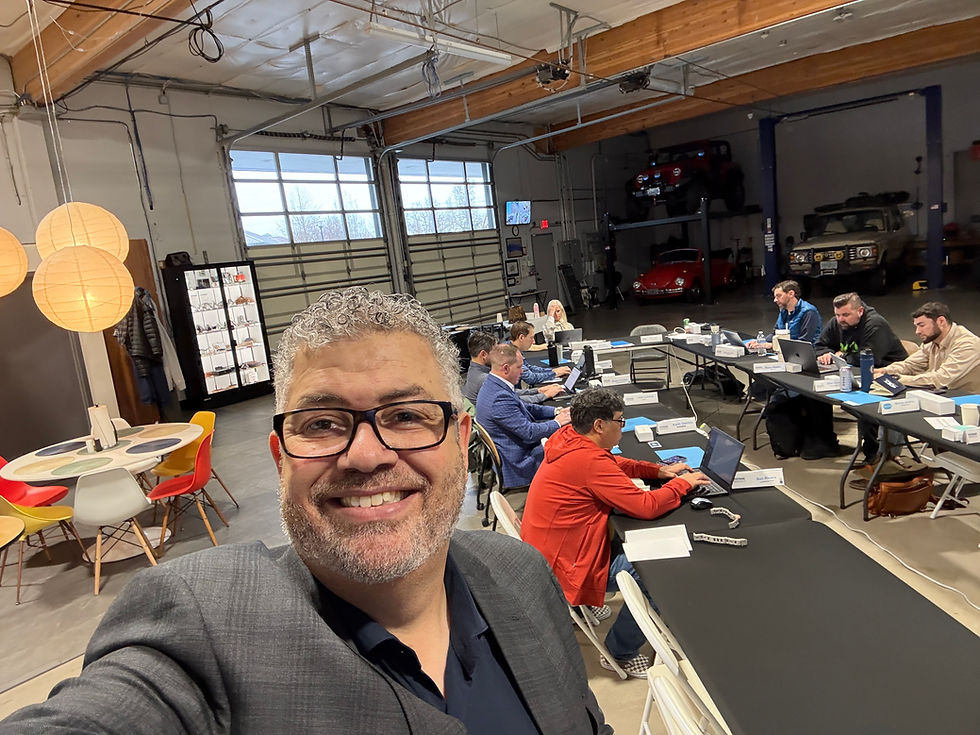
That's our conviction after working with leaders across CEO advisory groups this past year, and it's exactly what came through in Ontario, Canada on December 17, 2025. When we strip away the headlines and the hype, leaders are asking a much more practical question:
How do we use AI in a way that improves customer experience and drives strategic growth without adding another layer of complexity?
The feedback and survey responses from this session were refreshingly honest. There was excitement, yes, but it wasn't wide-eyed. It was grounded in the realities of time, data, risk, and execution. One leader wrote, "We want to implement with something simple and grow from there." Another said, "Thanks for opening our eyes to this. It's been on my radar for over a year and I have not made it priority."
That's the moment we care about most: when "this is interesting" becomes "this is now."
What Leaders Said Out Loud (and What They Implied)
Before we get into the numbers, let's highlight a few comments that captured the tone of the room. These aren't polished marketing lines. They're real reactions from real operators.
"Fantastic seminar. Learned a lot about new ways to adapt AI into our business to improve efficiency."
"It was great getting out of the weeds and learning different ways on addressing our challenges."
"Getting an AI champion inside my organization seems to be the biggest challenge."
One comment also surfaced a tension we've seen everywhere: leaders want relevance to the systems they already use.
"I know several businesses are within the Microsoft environment… would have liked a little more examples with Microsoft. Maybe it's not possible and we have to work in multiple worlds to get the best solutions!"
That is a very practical version of transformation. Most organizations don't get to start fresh. They have a tech stack. They have habits. They have constraints. And they still need customer engagement to improve, not stall.
So let's talk about what the survey revealed, because it tells us exactly where AI strategy breaks down and what it takes to turn AI curiosity into competitive advantage.
The Ontario Survey: 7 Signals You Can't Ignore
37 leaders completed the survey. This group skewed senior, as you would expect in CEO advisory groups:
10 were CEOs/Owners (27.0%)
10 were Presidents/GMs (27.0%)
12 were VPs/Directors (32.4%)
3 were other C-suite (8.1%)
Company size also mattered:
10 came from 1–50 employees (27.0%)
20 came from 51–250 employees (54.1%)
7 came from 251–1,000 employees (18.9%)
These aren't "AI hobbyists." These are leaders responsible for outcomes.
1. Ownership is split, and that slows everything down
When asked who is the single person responsible for driving AI and automation outcomes:
CEO/GM (named, accountable): 14 of 37 (37.8%)
No clear owner: 13 of 37 (35.1%)
Functional leader (Sales/Ops/IT): 6 of 37 (16.2%)
A working group, but no single owner: 4 of 37 (10.8%)
This is the first fork in the road for AI leadership. Without a clear owner, AI becomes fragmented: a few experiments, a few pockets of interest, and no operational rhythm.
2. Reaction speed is improving, but not fast enough
When a key performance number drops 15%, how quickly can teams make a change in production?
Within a month / quarterly: 16 of 37 (43.2%)
Within a week: 15 of 37 (40.5%)
Same day: 3 of 37 (8.1%)
Rarely, or only in crisis mode: 3 of 37 (8.1%)
If you're trying to build competitive advantage, this is a big deal. Faster feedback loops create better customer insights, which creates better decisions, which creates better customer outcomes. Slow loops create drift, then panic, then reactive decisions.
3. Data readiness is the hidden bottleneck
If leaders wanted to run a 30-day AI pilot this month, what data is already ready?
Scattered or siloed exports only: 16 of 37 (43.2%)
Raw data we could label if needed: 13 of 37 (35.1%)
Nothing accessible yet: 5 of 37 (13.5%)
A clean, labeled dataset with access controls: 3 of 37 (8.1%)
This is why many AI initiatives stall after the first excitement. The team realizes the data is there, but it's not usable. Or it's usable, but it's not governed. Or it's governed, but no one has the time to structure it.
4. Safety guardrails are behind adoption
How strong are current rules for using AI safely?
No protections in place yet: 14 of 37 (37.8%)
Rules exist but only partly enforced: 11 of 37 (29.7%)
Informal habits, no consistent enforcement: 11 of 37 (29.7%)
Sensitive data blocked, activity logged and reviewed: 1 of 37 (2.7%)
That last number is the one that should make every leader pause. If customer experience is part of your brand promise, trust is part of your brand promise. You cannot build customer engagement on top of inconsistent guardrails.
5. Most pilots are not making it into production
In the last 12 months, how many AI or automation pilots made it into production?
0 (pilots only so far): 21 of 37 (56.8%)
1–2: 14 of 37 (37.8%)
3 or more: 2 of 37 (5.4%)
This is one of the most common patterns we see: teams experiment, learn a little, and then hit the wall of adoption. That wall is usually not the tool. It's the absence of a repeatable implementation pathway.
6. KPI ownership is still missing
Which statement best describes today?
No KPIs tied to AI yet: 28 of 37 (75.7%)
Track results occasionally, but no one owns a KPI: 6 of 37 (16.2%)
At least one use case has clear KPI, named owner, regular review cadence: 3 of 37 (8.1%)
AI strategy becomes real when it's measured. Not measured once. Measured consistently, owned clearly, reviewed regularly.
7. Confidence exists, and it's a resource if you channel it well
On a scale of 1–10, confidence that the company will be competitive in AI by 2027:
Average: 6.7 out of 10
Median: 7 out of 10
18 of 37 (48.6%) rated themselves 8–10
7 of 37 (18.9%) rated themselves 1–4
That split is important. Nearly half are optimistic. Nearly one-fifth are anxious. Both are rational, depending on what's happening inside the business. The bridge between those two mindsets is capability.
And here's the signal we find most promising:
Do you want to learn more about developing an internal AI Systems Generalist?
Yes: 32 of 37 (86.5%)
No: 5 of 37 (13.5%)
Leaders understand something deeply practical: tools do not scale themselves. People scale.
What Leaders Want AI to Do (and What's Getting in the Way)
When asked the #1 outcome they want from AI:
Revenue growth: 17 of 37 (45.9%)
Cost reduction: 9 of 37 (24.3%)
Customer experience: 7 of 37 (18.9%)
Talent/skills gap: 3 of 37 (8.1%)
Risk & compliance: 1 of 37 (2.7%)
And the #1 blocker:
Talent/skills: 22 of 37 (59.5%)
Data quality: 6 of 37 (16.2%)
Leadership buy-in: 5 of 37 (13.5%)
Tech stack/tools: 4 of 37 (10.8%)
This pairing is the heart of what BREATHE! Exp is built to solve: we don't treat AI as a technology rollout. We treat it as a capability build.
Because the blocker is not curiosity. The blocker is internal skill, ownership, and execution.
A 30-Day Learning Moment: How to Make AI Useful Fast
If you're reading this and thinking, "Yes, that sounds like us," here is a practical 30-day framework we recommend. It's designed to help you create traction quickly while protecting customer experience and building internal confidence.
Week 1: Pick one customer-facing outcome and define "better"
Choose one measurable outcome tied to customer engagement or customer-facing speed. Keep it narrow.
Examples:
Reduce response time to inbound leads
Improve lead quality by clarifying customer insights and messaging
Increase conversion on a core offer by tightening positioning
Reduce time spent creating proposals, follow-ups, or FAQs
Improve consistency in customer communication across the team
If you want AI to matter, it must be anchored to an outcome the business actually cares about.
Week 2: Create a "minimum safe" dataset and basic guardrails
You don't need perfect data. You do need safe data and consistency.
Minimum guardrails to put in writing:
What can never be entered into public AI tools
When human review is required before anything reaches customers
Where prompts and outputs will be stored so the team can reuse and improve them
Who approves new use cases
This is where AI leadership shows up in a way your team can feel.
Week 3: Build a small prompt pack that supports one workflow
Instead of asking people to "use AI," give them a short set of prompts that map to a real workflow.
A simple prompt pack often includes:
A customer persona summary prompt (to capture customer insights consistently)
A message clarity prompt (to ensure your language supports customer experience)
A response draft prompt (for email, support, follow-up)
A quality check prompt (tone, accuracy, compliance, and next steps)
Week 4: Review results, adjust, and decide
This is the missing step in most companies.
Decide one of three things:
Scale it with training and oversight
Adjust and run a second 30-day cycle
Stop it because it didn't move the KPI
That decision, made consistently, is how transformation becomes a system, not a one-off.
Why GPS Summit Is Built for This Moment
The Ontario survey results showed a predictable pattern:
✓ Leaders want growth and efficiency
✓ Most pilots aren't reaching production
✓ KPI ownership is missing
✓ Talent and skills are the biggest blocker
✓ And 86.5% want to learn how to develop an internal AI Systems Generalist
That's exactly why GPS Summit exists: to create internal capability that turns AI strategy into execution, and execution into competitive advantage.
GPS Summit is a three-day intensive (February 25-27, 2026) that develops your high-potential leader into an AI Systems Generalist—the internal connector who can:
✓ Translate AI opportunities into workflows across departments
✓ Lead responsible adoption with clear guardrails
✓ Turn customer insights into measurable outcomes
✓ Build repeatable implementation pathways that scale
Your HiPo will leave with:
A 90-day implementation roadmap specific to your business
Hands-on skills they'll use Monday morning (not theory)
A peer network of AI Systems Generalists from other organizations
The confidence to lead AI adoption without adding complexity
This is People-Process-Tech integration in action. This is how you close the gap between "pilots only" and "operational advantage."
Take the Next Step
Explore GPS Summit: https://www.breatheexp.com/gps-summit
Enroll your high-potential leader in GPS Summit: https://www.breatheexp.com/event-details/breathe-gps-summit
See the full competitive comparison: https://www.breatheexp.com/corporate-cohort
About BREATHE! Exp: https://www.breatheexp.com/
Closing Question
If you could appoint one AI Systems Generalist and give them a 30-day mission to improve customer experience in a measurable way, what would you choose as the first workflow to fix?
And what would change in your business if that person had the skills, confidence, and peer network to make it happen—not just once, but again and again?
BREATHE! Exp is a strategic growth firm that develops internal AI capability through world-class learning experiences. GPS Summit is our flagship three-day intensive for organizations ready to turn AI pilots into competitive advantage.


Comments