
Making AI Practical: What CEOs Asked for in Tualatin

Updated: Jan 24
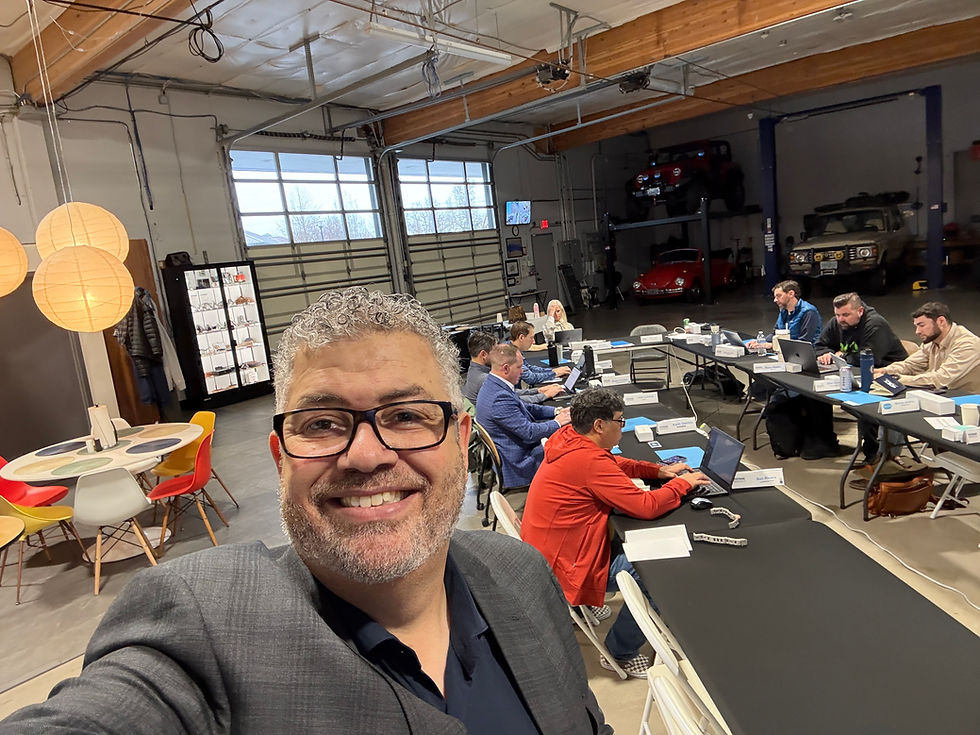
Tualatin, Oregon, December 9, 2025 — I believe AI should make leadership easier, not busier.
Not because it magically removes complexity, but because the right AI strategy helps a team see the signal faster, decide faster, and execute faster—without lowering the bar on customer experience. That is the difference between "AI as a new task" and AI as real competitive advantage.
On December 9, 2025, I was in Tualatin, Oregon with leaders from CEO advisory groups, and the feedback was both encouraging and instructive:
Content: 5 out of 5
Deliverability: 4.25 out of 5
Applicability: 5 out of 5
Would Recommend: 100%
That combination tells us two things at once. The value landed. And we can keep tightening the path so leaders get to the most useful parts even faster.
One comment captured the tension perfectly:
"I had to step out during a key moment of the presentation so it is hard for me to gauge the value. I would say that it took a while before we got into the core content. I would have preferred a shorter setup in order to get into the core content faster."
Another comment reminded us what leaders truly want from any session on transformation:
"Super interesting. Appreciated that we spent time actually doing the work vs just hearing about it."
That's the bar. Less talk. More doing. More clarity. More traction that shows up in the week ahead.
What the Survey Revealed About Real AI Readiness
Nine attendees completed a short survey during or right after the session. When leaders answer anonymously, the patterns become honest fast. Here are the signals that matter most if you care about strategic growth, customer engagement, and adoption that actually sticks.
1. AI leadership is still a single-owner problem
When asked who is the single person responsible for driving AI and automation outcomes:
4 of 9 (44.4%) said the CEO/GM is the named, accountable owner
3 of 9 (33.3%) said there is no clear owner
1 of 9 (11.1%) said a functional leader (Sales/Ops/IT)
1 of 9 (11.1%) said there's a working group, but no single owner
So yes, nearly half have a clear accountable owner. But more than half (5 of 9, 55.6%) are operating without one clear person who owns outcomes.
That is the first place AI strategy breaks down. Not because people are lazy or resistant, but because "everyone is responsible" often means "no one is accountable."
2. Most teams cannot change fast when numbers drop
When asked how quickly teams can make a change in production when a key performance number drops 15%:
5 of 9 (55.6%) said within a month / quarterly
2 of 9 (22.2%) said within a week
1 of 9 (11.1%) said same day
1 of 9 (11.1%) said rarely, or only in crisis mode
This matters because the market is not slowing down. Customer expectations are not slowing down. Competitive pressure is not slowing down. If your response cycle is a month, your competitors are learning faster than you.
AI is not the point. Decision speed is the point.
3. Data readiness is "almost," not "ready"
If they wanted to run a 30-day AI pilot this month, what data do they already have ready?
5 of 9 (55.6%) said raw data they could label if needed
2 of 9 (22.2%) said scattered or siloed exports only
1 of 9 (11.1%) said nothing accessible yet
1 of 9 (11.1%) said a clean, labeled dataset with access controls
Most companies are not starting from zero. But they are also not set up for speed. "Raw data we could label" is hopeful. It's workable. It is also a sign that someone still has to do the unglamorous work of turning scattered information into usable customer insights.
4. Guardrails are still catching up
How strong are current rules for using AI safely?
3 of 9 (33.3%) said no protections in place yet
3 of 9 (33.3%) said rules exist but are only partly enforced
2 of 9 (22.2%) rely on informal habits (no consistent enforcement)
1 of 9 (11.1%) said sensitive customer/company data is blocked from entering AI tools, and activity is logged and reviewed
If you care about customer experience, you have to care about trust. And trust is built through consistent behavior, not good intentions.
The good news is that this is fixable quickly, if leadership decides it matters.
5. Most pilots are not making it into production
In the last 12 months, how many AI or automation pilots have made it into production?
6 of 9 (66.7%) said 0 (pilots only so far)
2 of 9 (22.2%) said 3 or more
1 of 9 (11.1%) said 1–2
This is a classic pattern: enthusiasm up front, experimentation in pockets, then a stall before operational adoption. The gap is not inspiration. The gap is implementation leadership.
6. KPIs are not tied to AI yet
Which of these is true today?
7 of 9 (77.8%) said they don't have any KPIs tied to AI yet
2 of 9 (22.2%) said at least one use case has a clear KPI, a named owner, and a regular review cadence
This is where AI in every function gets mismanaged. If you cannot tie the work to outcomes, it becomes a hobby. If it becomes a hobby, it gets cut the moment the quarter gets tight.
7. Leaders want growth, but feel constrained by skills
What's the #1 outcome they want from AI?
Revenue growth: 7 of 9 (77.8%)
Cost reduction: 1 of 9 (11.1%)
Customer experience: 1 of 9 (11.1%)
What's the #1 blocker to AI adoption?
Talent/skills: 4 of 9 (44.4%)
Budget: 2 of 9 (22.2%)
Leadership buy-in: 1 of 9 (11.1%)
Tech stack/tools: 1 of 9 (11.1%)
Regulation/compliance: 1 of 9 (11.1%)
This is why capability beats tools.
You can buy software in an afternoon. You cannot buy internal confidence, cross-functional execution, and strong decision-making by Friday. That is built.
The Most Honest Line in the Written Comments
One written response made us stop, because it exposes what so many organizations are quietly experiencing:
"Great job, good information. I don't have anyone on the team to be our AI hero at the moment."
That is not a complaint. That is clarity.
And clarity is exactly where momentum begins.
If no one on the team can connect systems, translate business needs into use cases, and lead responsible adoption, then AI becomes a set of disconnected experiments. Some of them might be interesting. Few of them become durable competitive advantage.
What Leaders Actually Want from an AI Session
The feedback from Tualatin gave us a useful reminder: leaders do not need a longer setup. They need a faster bridge between understanding and action.
Here is what your peers valued most:
✓ Hands-on practice, not theory
✓ Tools and exercises that can be used immediately
✓ Clear steps they can take without adding a new layer of meetings
That is the positioning edge BREATHE! Exp is built around. We are not here to sell AI as a trend. We are here to help leaders create internal capability that makes transformation practical.
And when leaders tell us they want to "get to the core content faster," we take that as a promise we need to keep. Your time is not unlimited. Your attention is not unlimited. The work still has to get done.
A Learning Moment You Can Use in the Next 7 Days
If you want AI strategy to translate into strategic growth and better customer engagement, here is a simple approach that works whether you are in marketing, operations, sales, or customer support.
Step 1: Name one accountable owner
Not a committee. Not "someone in IT." One person who owns outcomes and can coordinate across functions.
If you do not have that person today, be honest. Then decide whether you will build one internally.
Step 2: Pick one outcome tied to customers
Choose a goal that improves customer experience or revenue. Make it measurable.
Examples that work for smaller teams:
Improve speed-to-response in customer inquiries
Improve lead quality by clarifying persona and messaging
Reduce time spent creating sales follow-up and proposals
Improve conversion rate on a key offer by sharpening customer insights
Reduce support ticket volume by improving self-service answers
Step 3: Create a "minimum safe" dataset
You do not need perfect data. You need usable data and clear guardrails.
Ask:
What customer data is safe to use?
What data must never be entered into public AI tools?
Where will prompts and outputs live so the team can reuse and improve them?
Who reviews outputs before they touch the customer?
Step 4: Run a 30-day pilot that ends in a decision
A pilot without a decision is just activity.
Your pilot should include:
One KPI
One owner
Weekly check-ins (15 minutes is enough)
A short list of prompt templates that the team can reuse
A rule for validating outputs before they go public
Step 5: Turn the win into a reusable system
This is where AI becomes leverage, not extra work.
When you turn your best prompts, workflows, and review steps into a repeatable operating rhythm, you get faster over time. That is how competitive advantage compounds.
Why GPS Summit Is the Next Step for Many Teams
The survey results and comments from Tualatin point to a consistent truth: most companies are not short on ideas. They are short on internal capability.
GPS Summit exists to build that capability through a clear pathway, so your organization is not dependent on a handful of early adopters or outside vendors to move forward.
GPS Summit is a three-day intensive (February 25-27, 2026) that develops your high-potential leader into an AI Systems Generalist—the internal connector who can:
✓ Translate AI opportunities into workflows
✓ Lead responsible adoption across departments
✓ Turn customer insights into measurable outcomes
✓ Build guardrails that protect trust while enabling speed
Your HiPo will leave with:
A 90-day implementation roadmap specific to your business
Hands-on skills they'll use Monday morning
A peer network of AI Systems Generalists from other organizations
The confidence to lead AI adoption without adding chaos to the week
This is not about chasing trends. This is about building internal AI capability so your team can move faster with more confidence, and create competitive advantage that sticks.
Take the Next Step
Explore GPS Summit: https://www.breatheexp.com/gps-summit
Enroll your high-potential leader in GPS Summit: https://www.breatheexp.com/event-details/breathe-gps-summit
See the full competitive comparison of our corporate cohort: https://www.breatheexp.com/corporate-cohort
Learn more about BREATHE! Exp: https://www.breatheexp.com/
One Last Question to Sit With
If you could make one change this quarter that would improve customer experience and free your team's time at the same time, what would you choose to pilot first?
And who on your team could become the AI Systems Generalist who makes that pilot—and everything that follows—safer, faster, and easier for everyone else?
BREATHE! Exp is a strategic growth firm that develops internal AI capability through world-class learning experiences. GPS Summit is our flagship three-day intensive for organizations ready to turn AI strategy into a competitive advantage.


Comments