
AI Feels Like a Huge Elephant. Here Is How to Eat It.


Why AI Feels Overwhelming — and Why That Feeling Is Actually a Good Sign
There is a specific kind of overwhelm that shows up in rooms full of capable business leaders when the full scope of Artificial Intelligence comes into focus. It is not the paralysis of someone who does not understand the opportunity. It is the overwhelm of someone who understands it clearly and is suddenly confronted with the distance between where they are and where they need to be. That feeling — the sense of facing something immense and not yet knowing how to begin — is not a warning sign. It is a signal of genuine comprehension. And it is exactly the right place to start.
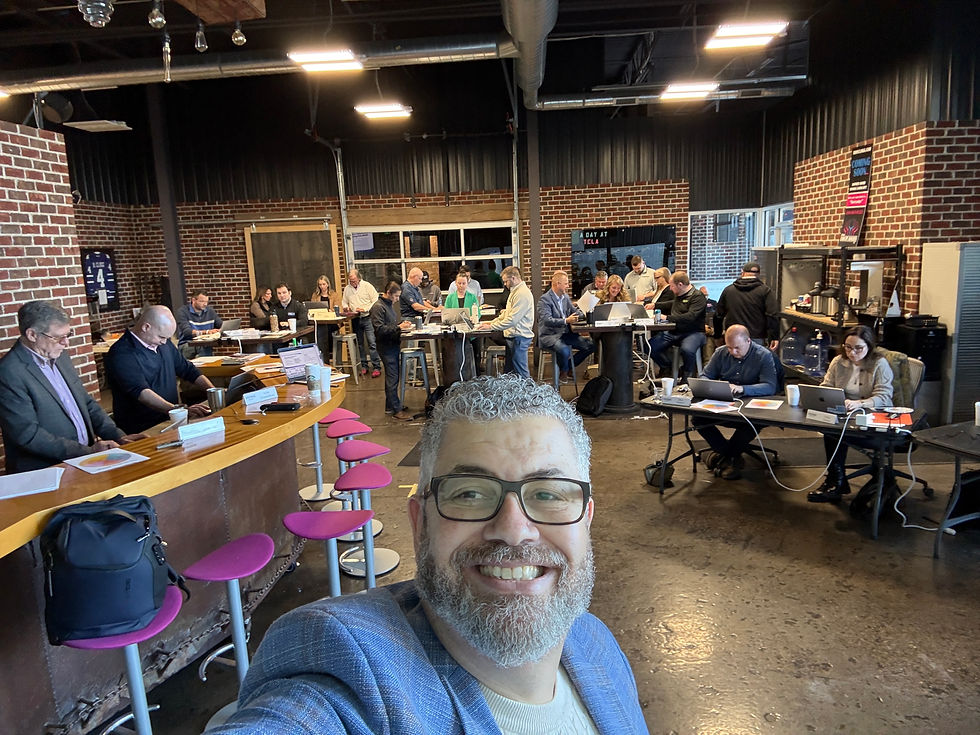
On March 26, 2026, a CEO advisory group gathered in Mesa, Arizona for a GPS Summit workshop that produced both of those experiences simultaneously — the exhilaration of a full picture of what AI makes possible, and the honest reckoning with how much organizational work is required to get there. The session earned a 4.75 out of 5 across all three rating categories — Quality of Content, Quality of Delivery, and Applicability — and a 100 percent recommendation rate. But the most revealing content of the morning came not from the presentation. It came from the survey data that nine business leaders filled out about their companies' actual AI readiness. And it confirmed, with unusual clarity, exactly why the sense of facing a large challenge is both accurate and completely solvable.
What Nine Mesa Leaders Revealed About the State of AI Readiness
The Mesa session brought together leaders from steel fabrication, electrical contracting, e-commerce, HVAC, consulting and coaching, biomedical manufacturing, medical devices, and consulting engineering. Companies ranging from under 50 employees to over 250. A spread of roles from CEO and owner to VP, director, and functional leader. And a set of AI readiness responses that, taken together, paint one of the clearest pictures yet of where mid-market companies across the trades, manufacturing, and professional services sectors actually stand.
The numbers are stark:
100% had no KPIs tied to AI outcomes. Every single company in the room — all nine — had no measurable standard for AI performance. No metric. No owner. No review cadence. No accountability structure. This was a unanimous response, and it is the single most consequential gap in the data.
89% had zero AI pilots in production. Eight of nine companies had not yet moved a single AI initiative from experimentation into live deployment. No production-grade output. No real-world performance data. No measurable business impact from AI yet.
78% had no effective AI safety governance. Nearly four in five companies were operating with either zero AI protections or only informal, inconsistently applied habits — meaning there are no enforceable guardrails for how AI tools are used or what data flows through them.
67% named talent and skills gaps as their biggest AI blocker. This answer has now dominated the GPS Summit series from Nebraska through Michigan, Colorado, and Arizona. The technology is not the obstacle. The absence of people who know how to deploy it inside real organizations is.
67% named revenue growth as their primary AI goal. More than two thirds of the room came in with the same north star — they want AI to drive Business Growth. And yet the infrastructure to pursue that goal is almost entirely absent.
44% had no accessible data whatsoever for an AI pilot. Nearly half the group said they had nothing ready — no structured data, no organized exports, no starting point for a meaningful AI initiative today. Another 22 percent had only scattered, siloed exports that would require significant work before they could support any real AI deployment.
AI confidence scores ranged from 3 to 10, averaging 6.1 out of 10. The leaders at the high end — the ones at a 9 and a 10 — were not more optimistic by nature. They had already made organizational decisions that the others had not: they had a named AI owner, they had data in some state of readiness, and they had begun deploying and measuring. The leaders at the lower end of the confidence range were looking at the same distance the others had already started crossing. The difference was not intelligence or ambition. It was a starting decision.
"Great presentation — feel like a huge elephant to take on." — Marti W., Black Label Steel
Marti's comment is one of the most honest and instructive pieces of feedback in the GPS Summit series. She is not saying AI is not relevant to her business. She is saying it feels immense. And when you look at the data — 100 percent of companies with no KPIs, 89 percent with no live pilots, 78 percent with no governance, 44 percent with no accessible data — the feeling is warranted. The elephant is large. But the answer to a large elephant is not to stare at the whole thing and hope it gets smaller. It is to identify the first actionable piece, build the capability to execute it, and let the momentum from that first win create the confidence and the infrastructure for everything that follows. That is exactly the process the GPS Summit is designed to drive.
Learning AI by Doing It: The Method That Actually Works
"Hands down in the last 5 years as an active member in a CEO advisory group, this provided the best bang for my buck on every level. The ability to communicate a new world era that we are evolving at 10x rapidly in a manner that you are doing the work in the moment to learn it. Amazing." — Mesa Workshop Attendee, March 26, 2026
This is the feedback that captures what separates the GPS Summit workshop experience from every other AI presentation that business leaders have sat through. The phrase worth focusing on is doing the work in the moment to learn it. Not listening to someone describe how AI works. Not watching demonstrations on a screen and taking notes to review later. Actually working with the tools, building with the concepts, applying the frameworks to real business situations in real time. That kind of learning does not just inform — it transforms. It converts abstract understanding into embodied capability, and that capability persists long after the session ends.
The feedback also captures something important about the pace of the current moment: we are evolving in AI at 10x the rate of any previous technology era. This is not hyperbole. The leaders who were experimenting with basic language model tools eighteen months ago and the leaders who are building autonomous AI agents and integrated workflow systems today are separated by a capability gap that would have taken a decade to develop in previous technology cycles. The implications for Competitive Advantage are profound — and the urgency for every business leader who wants to compete effectively over the next three to five years is real.
Process and Workflow: The AI Capability Most Companies Need First
One of the Mesa session's group reviews called for more depth on process and workflow building with AI — and this request points at something important. For most mid-market companies, the highest near-term value from AI does not come from the flashiest tools or the most sophisticated applications. It comes from workflow automation: the systematic replacement of repetitive, time-intensive internal processes with AI-powered systems that free team members to focus on higher-value work.
Consider what workflow automation means for the kinds of companies in the Mesa room: an HVAC business that automates service call routing, customer follow-up, and parts ordering. A steel fabrication company that automates project status updates, supplier communications, and quote generation. A biomedical company that automates compliance documentation, sales pipeline tracking, and Customer Engagement sequences. An electrical contractor that automates scheduling, change order management, and Customer Experience touchpoints. In each case, the impact is not marginal — it is structural. It changes what the team can accomplish with the same headcount, and it creates the operational foundation on which more advanced AI capabilities can be built over time.
Building these workflow systems — identifying the right processes to automate, selecting the right tools, designing the integration architecture, and training the team to maintain and improve the systems over time — is one of the core capabilities that GPS Summit participants develop. It is applied AI Leadership at its most practical and most immediately valuable.
The 100% KPI Problem and What It Means for Every Investment You Make
When every single company in a room says they have no KPIs tied to AI outcomes, something important is being revealed about how AI is being treated organizationally. It is being treated as a special category — one that is exempt from the accountability structures that govern every other business function. No one runs a sales team without measuring revenue. No one manages a service operation without tracking customer satisfaction. But AI, despite consuming real time, budget, and organizational attention, is being evaluated on vibes rather than metrics in the vast majority of mid-market companies right now.
This has to change — and not because accountability is a virtue in the abstract, but because it is the practical mechanism that drives improvement. When you measure AI performance, you discover what is working and what is not. You can allocate resources toward the initiatives producing results and deprioritize the ones that are not. You can identify where the Customer Insights generated by AI are improving decision quality and where the AI in Marketing investments are driving genuine revenue lift versus generating activity without conversion. Without KPIs, none of that optimization is possible. And without optimization, the AI investments that felt promising in the pilot phase never compound into the Business Growth results that justified them.
When the Leader's Buy-In Is Not the Problem — But the Team's Isn't Either
Two of the nine Mesa attendees named leadership buy-in as their biggest AI blocker. This is the answer that requires the most careful unpacking, because in a CEO advisory group, the person giving this answer is often the most senior leader in their organization. When a CEO or owner says leadership buy-in is their biggest blocker, they are almost never talking about themselves. They are describing a layer of the organization — a management team, a board, a key department head — whose skepticism, indifference, or competing priorities is slowing AI adoption down.
The solution is rarely a matter of presenting more evidence. Decision-makers who are resistant to AI have usually already encountered the evidence. What they have not encountered is a credible, specific business case — one that speaks their language, addresses their concerns, and connects AI to the outcomes they already care about and are already accountable for. An internal AI leader who has been developed through a program like the GPS Summit walks into that conversation with exactly that capability: the ability to translate AI Strategy into the language of business outcomes that moves the people who control the resources.
How You Eat the Elephant: One Bite at a Time, With the Right Guide
The answer to a large, complex challenge is never to avoid it. It is to break it down, sequence it intelligently, and build momentum from early wins. The AI elephant that Marti described in Mesa is the same elephant that hundreds of business leaders across the GPS Summit series have encountered — the moment when the full scope of what AI requires becomes visible all at once. What the leaders who have moved furthest on AI have in common is not that the elephant was smaller for them. It is that they had a guide. Someone inside the organization who could say: here is where we start, here is the sequence, here is the first measurable outcome we are building toward.
The GPS Summit develops that guide. It is a structured leadership development program that takes your most capable high-potential leader and equips them with the AI Strategy, the Digital Transformation frameworks, the governance tools, and the execution playbook to lead your company's AI journey from the inside out — not in theory, but in practice, with real accountability and measurable outcomes from day one.
Here is what GPS Summit participants are equipped to deliver:
A sequenced AI Strategy that starts with the highest-value, most achievable use cases and builds toward advanced AI capability over time — so the first bite of the elephant produces real results and the momentum carries the organization forward.
AI workflow and process automation — the practical, hands-on capability to identify the right processes to automate, select and deploy the right tools, and build the internal systems that free the team to focus on higher-value work.
KPI development and AI accountability structures that bring AI performance under the same measurement discipline as every other business function — enabling the optimization loop that turns promising pilots into compounding Business Growth results.
AI governance frameworks that protect data, establish enforceable usage policies, and build the internal trust that makes broader AI adoption safe to accelerate.
Applied AI in customer-facing outcomes — including Customer Experience design, Customer Engagement automation, AI in Marketing execution, and Customer Insights generation that improve decision quality and drive revenue.
The organizational credibility to drive buy-in — presenting AI initiatives in business terms that move skeptical decision-makers from resistance to sponsorship.
To learn more about the GPS Summit and what makes it different from every other AI leadership program available, visit the GPS Summit overview page or review the full competitive comparison.
The Elephant Does Not Get Smaller. The Leader Gets Better.
The Mesa session stood out for something that goes beyond its ratings, beyond its survey data, and beyond any individual comment. It was a room that chose honesty over performance. Leaders who acknowledged they felt overwhelmed. Leaders who named the real gaps in their organizations without minimizing them. Leaders who sat through a session that confirmed both the scale of the AI opportunity and the scale of the work required — and responded not with skepticism but with the words that matter most: what do I do next?
That question is the most important one a business leader can ask about AI right now. Not whether AI matters — every leader in Mesa already knew the answer to that. Not whether their company has gaps — the survey data confirmed that for all nine of them. But what to do next. That is where the GPS Summit begins. And it is where the leaders who attend it leave with something the rest of the market does not have: a clear path, a capable guide inside their own organization, and the momentum of having already taken the first step.
The leader who attended the Mesa session and described five years of CEO advisory group participation leading up to this as the best value they had received — that assessment was not about a single morning. It was about the recognition that the conversation had finally shifted from what AI is to what to do about it. That shift is available to every leader reading this. The work of making it permanent — building the internal AI Leadership capability that sustains the shift — is what the GPS Summit delivers.
When you are ready to enroll your high-potential leader and give them the foundation to guide your company through the AI transformation ahead, enroll them in the GPS Summit here. To learn more about BREATHE! Experience and the full program, visit breatheexp.com.
What would your business look like in two years if the right person inside your organization had started eating the AI elephant — one strategic bite at a time — starting today?


Comments