
Perfect Scores, Real Gaps: What Tucson CEOs Taught Us


When a Room Scores You Perfectly, Listen Even More Carefully
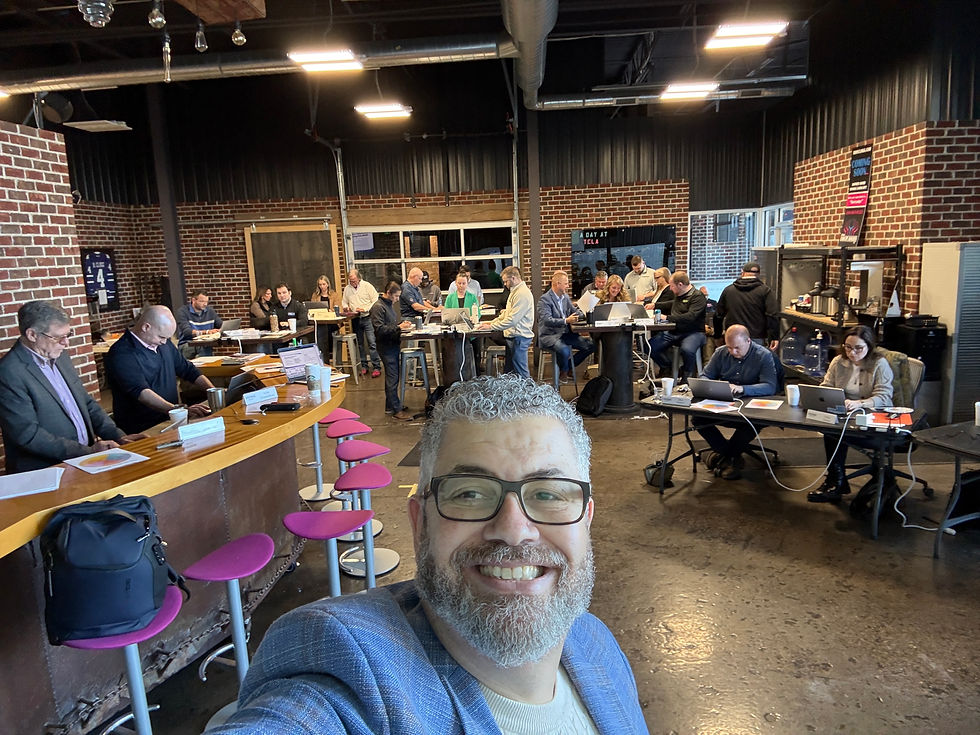
A perfect score from a room full of business leaders who have seen every kind of presentation, sat through every kind of workshop, and developed a finely calibrated sense for what is genuinely useful versus what is window dressing — that score means something. It is not politeness. It is signal. On March 24, 2026, a CEO advisory group gathered in Tucson, Arizona and gave the GPS Summit workshop a 5 out of 5 for Quality of Content, a 5 out of 5 for Quality of Delivery, a 5 out of 5 for Applicability, and a 100 percent recommendation rate. Every single category. Every single metric. A clean sweep.
But the most instructive part of that morning was not the ratings. It was what the survey data underneath the ratings revealed about where these companies actually stand on Artificial Intelligence — the honest, unfiltered portrait of a group of growth-minded leaders who know AI matters, know they are not where they need to be, and are ready to do something about it. That combination of intellectual honesty and genuine readiness is exactly what produces a perfect score. And it is exactly the profile of the leaders the GPS Summit is built to serve.
The Tucson Data: A High-Clarity Picture of Where AI Stands
The Tucson session brought together leaders from construction, paving and civil work, healthcare, manufacturing, real estate asset management, and transportation and logistics. Seven companies. A range of sizes from under 50 employees to over 1,000. And a survey readout that — despite the wide diversity of industries represented — told a remarkably unified story about the current state of AI adoption across the mid-market business landscape.
Here is what the data showed:
71% had no KPIs tied to AI outcomes. More than two thirds of the room had no measurable standard for what AI success looks like in their organization — no way to evaluate performance, optimize investments, or hold anyone accountable for results.
71% named talent and skills gaps as their single biggest AI blocker. This was the dominant response by a wide margin — matching closely with what CEO advisory groups across the country are reporting as the defining friction point between their AI ambitions and their AI reality.
57% had zero AI or automation pilots in production. The majority of companies in the room were still in experimentation mode — with no live deployment generating real-world feedback or measurable business outcomes yet.
43% had no clear owner for AI in their business. Nearly half the group had no named individual accountable for moving AI forward — a structural gap that reliably predicts slow adoption regardless of how strong the intention to move is.
43% had no AI safety protections whatsoever. For a room that included healthcare, manufacturing, and transportation companies — all industries with meaningful data sensitivity — this represents a significant governance exposure that compounds with every new AI tool adoption.
71% named revenue growth as their primary goal for AI. This was the number one desired outcome for the Tucson group by a commanding margin — and it speaks directly to where the business case for AI is most compelling and most actionable when the right strategy and the right leader are in place.
Confidence that their company would be competitive in AI by 2027 averaged 6.0 out of 10, ranging from 4 to 9. The spread is instructive: the leader at a 9 had already deployed three or more pilots and had a functioning KPI structure in place. The leaders clustering around 4 and 5 were not disengaged — they were self-aware enough to recognize how much ground needs to be covered and honest enough to reflect that in their score. That kind of candor is the starting point for real progress.
Perhaps the most telling data point of all: when asked about their data readiness for a 30-day AI pilot, 43 percent described their data as scattered or siloed, and another 29 percent said they had nothing accessible at all. Only one company in the room had a clean, labeled dataset with proper access controls. For a group where 71 percent want AI to drive revenue growth, that gap between ambition and infrastructure is the precise challenge that needs to be solved before growth can actually happen.
What Tucson Teaches Every Business Leader About AI Readiness
The Tucson session reinforces a pattern that has emerged across every city in the GPS Summit series: the leaders most eager to drive Business Growth through AI are often the same ones furthest from having the organizational infrastructure to do it. This is not a contradiction. It is a description of exactly where the GPS Summit intervenes — between the clear desire for AI-driven results and the structured capability needed to produce them.
Revenue Growth and the AI Strategy That Gets You There
When 71 percent of a CEO advisory group says their primary AI goal is revenue growth, that is not a vague aspiration. That is a specific, measurable business outcome that Artificial Intelligence is exceptionally well positioned to deliver — through sharper Customer Insights that reveal where the highest-value opportunities in your market actually are, through AI in Marketing that reduces customer acquisition cost while increasing conversion, through Customer Engagement automation that deepens relationships at scale, and through Customer Experience improvements that increase retention and drive referral growth.
But here is the critical link that most AI conversations miss: revenue growth from AI does not flow from subscribing to a new tool or running a pilot. It flows from an AI Strategy — a deliberate, documented plan that identifies the specific revenue levers in your business, maps the AI capabilities that move those levers, assigns ownership to a leader who understands both the business and the technology, and establishes the KPIs that create accountability for results. Without that structure, AI investments produce interesting demonstrations and inconclusive experiments. With it, they produce revenue.
The Data Infrastructure Problem Hiding Behind Every AI Goal
The Tucson data revealed that 72 percent of attendees either had scattered, siloed data or nothing accessible at all for an AI pilot. This is the hidden constraint that trips up AI initiatives in virtually every industry — including the construction, healthcare, manufacturing, and logistics companies represented in that room. The AI tools are ready. The use cases are clear. The business case is compelling. But when the data that AI needs to function is fragmented across disconnected systems, locked in formats that are not machine-readable, or simply not yet collected in any structured way, even the best strategy cannot produce the results leaders are after.
Solving the data problem is not primarily a technology project. It is a leadership project. It requires someone inside the organization who understands what AI needs from data, can assess the current state clearly, and has the organizational influence to drive the cross-functional changes — in systems, in processes, in habits — that move a company from data chaos to data readiness. That person is the internal AI Leader. And in a room where only one company out of seven has data ready for an AI pilot, the value of developing that leader is not theoretical. It is urgent.
The Governance Gap in High-Stakes Industries
Forty-three percent of the Tucson group had no AI safety protections in place at all. For industries like healthcare, where patient data is governed by federal regulation, and for large construction and transportation companies managing significant contract, liability, and operational data, this is not an abstract risk. It is a live one. Every team member who uses an AI tool without a governance framework is making unilateral decisions about what data is safe to share, what outputs are trustworthy, and what the company's obligations are regarding AI-generated content — decisions that should be made at the organizational level with full awareness of regulatory and reputational implications.
The two Tucson companies that had already implemented sensitive data protections — with customer and company data blocked from entering AI tools and activity logged and reviewed — were among the most advanced in the room on every other AI readiness metric. This is not coincidence. Companies that take governance seriously early build the trust infrastructure that allows faster, more confident AI adoption over time. They are not slowed down by governance. They are accelerated by it.
The Construction Industry and the AI Opportunity It Cannot Afford to Miss
Three of the seven Tucson attendees came from the construction sector — spanning general construction, paving and civil work, and container controls manufacturing. This is a sector where the operational complexity is high, the margin pressure is real, and the potential for AI to drive meaningful improvements in cost management, project oversight, customer communication, and competitive bidding is enormous. Yet construction consistently appears in the GPS Summit data as one of the sectors furthest behind on AI readiness — with scattered data, missing governance, and no named AI owner being the norm rather than the exception.
The construction companies that build AI capability now — that develop the internal AI Leadership to drive Digital Transformation in their operations, their estimating, their customer-facing workflows, and their supply chain management — will hold a Competitive Advantage that will be very difficult for slower-moving competitors to close. The data problem is solvable. The talent problem is solvable. The governance problem is solvable. All three become solvable at once when the right internal leader is equipped to drive them.
Why a Perfect Score Points Directly to the GPS Summit
The Tucson group did not give perfect ratings because the session was entertaining. They gave perfect ratings because the content was immediately, unmistakably relevant to the exact challenges they are navigating in their businesses right now. A 5 out of 5 on Applicability from a CEO advisory group means every person in that room left with something they can use — a framework, a tool, a reframe, a path forward. That is not a low bar. It is the highest bar.
What a single session produces is the starting orientation. What the GPS Summit produces is the full capability — the AI Leadership development experience that takes the clarity generated in a session like Tucson and builds it into a permanent organizational asset. A trained, empowered, accountable internal AI leader who can own your AI Strategy from day one, close the data readiness gap, build the governance infrastructure, and connect AI directly to the revenue growth goals that the Tucson group named as their number one priority.
GPS Summit participants are equipped to:
Build a revenue-focused AI Strategy — mapping specific AI capabilities to the revenue levers that matter most in their industry and establishing the KPIs that make every AI investment accountable to a measurable outcome.
Assess and resolve data readiness gaps — diagnosing the current state of organizational data, identifying what needs to be structured, cleaned, or connected, and driving the cross-functional changes that move the company from data chaos to AI-ready infrastructure.
Implement AI governance frameworks — establishing data protection policies, usage guidelines, and output review standards that allow safe, scalable AI adoption in regulated and non-regulated environments alike.
Apply AI to Customer Experience, Customer Engagement, and AI in Marketing — connecting AI capabilities directly to the customer-facing outcomes that drive revenue growth, retention, and referral at scale.
Generate actionable Customer Insights — using AI to surface the patterns in customer behavior, market positioning, and competitive dynamics that human analysis alone consistently misses.
To learn more about the program and what sets it apart from every other AI leadership offering available, visit the GPS Summit overview page or review the full competitive comparison to see exactly how it stacks up.
What Perfect Ratings and Honest Data Are Telling You Together
There is something rare and genuinely valuable about a room that scores you perfectly and then tells you, through their survey responses, exactly how far they still have to go. That combination — high enthusiasm and honest self-assessment — is the profile of a leader who is ready to move. Not just ready to learn, but ready to act. The Tucson group was that room.
They came in knowing AI was important. They left knowing, with much greater clarity, exactly why their companies are not yet capturing the Competitive Advantage that AI makes available — and what the specific gaps are that need to be closed to get there. That clarity is worth more than any tool demonstration or high-level framework. It is the foundation for making a real decision: identifying the right person inside the organization, equipping them properly, giving them authority, and watching what they build.
The construction companies in Tucson are competing against other construction companies making the same margin calculations with the same data and the same labor constraints. The healthcare practice is navigating the same compliance pressures as every other healthcare practice in the market. The transportation and logistics company is operating in an industry being fundamentally reshaped by AI-driven routing, demand forecasting, and customer communication. In every one of these sectors, the differentiation that matters most over the next three to five years will not come from the tools a company buys. It will come from the leader a company develops.
When you are ready to invest in that leader and give them the foundation to own your company's AI future, enroll them in the GPS Summit here. To learn more about BREATHE! Experience and the full GPS Summit program, visit breatheexp.com.
How much of your company's AI potential is sitting untapped right now — not because the tools do not exist, but because the right person has not yet been equipped to unlock it?


Comments