
Time Is Not Your Biggest AI Blocker. Talent Is.

The Excuse That Is Costing Businesses the Most
Ask most business leaders why they have not moved further with Artificial Intelligence, and the answer comes back quickly: time. There is never enough of it. The day-to-day demands of running a company consume everything, and AI stays on the list of things that will get serious attention next quarter, after the hiring push, after the system upgrade, after the budget cycle closes. This is a story as old as every major technology shift in business history, and it is costing companies more than most of their leaders realize.
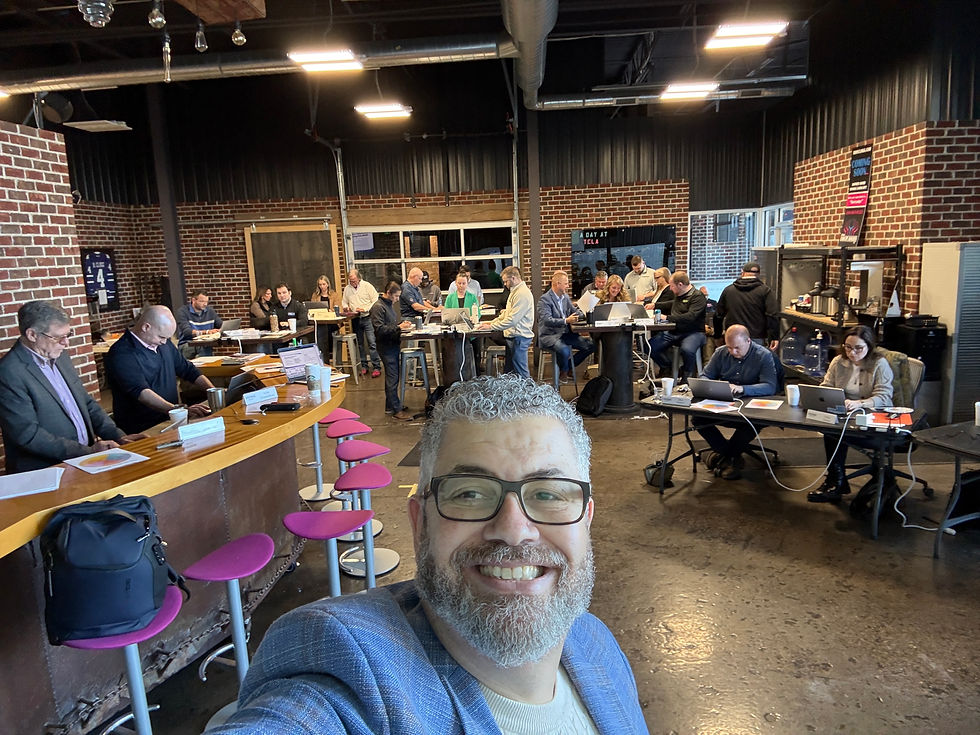
On March 11, 2026, a CEO advisory group gathered in Detroit, Michigan for an AI strategy workshop. Sixteen business leaders showed up representing industries spanning construction, manufacturing, dental services, workforce development, technology, transportation, industrial coatings, and nonprofit human resources. What the survey data from that morning reveals is not a time problem. It is a talent problem — and the distinction matters enormously, because a talent problem is one that can actually be solved.
As one facilitator in the room put it plainly: time is the number one perceived blocker. The operative word is perceived. Because when you look at what is actually standing between these organizations and real AI capability, the numbers point directly at the absence of skilled, accountable people — not the absence of hours in the day.
What Sixteen Detroit Leaders Revealed About Their AI Reality
The Detroit session on March 11th produced one of the clearest and most instructive data sets of the GPS Summit series to date. The group was diverse in industry and company size, but the pattern in their AI readiness responses was remarkably consistent. These were not companies ignoring AI — they were companies actively grappling with it, yet still running in place. Here is what the data showed:
62% had zero AI or automation pilots in production. Experimentation is happening in pockets, but it is not crossing the line into real operational deployment.
62% had no KPIs tied to AI outcomes. Nearly two-thirds of these organizations have no measurable standard for what AI success looks like inside their business.
69% identified talent and skills gaps as their single biggest blocker. This was the dominant response by a wide margin, named by nearly seven in ten attendees as the thing standing most directly between their company and AI progress.
Only 25% had a single, clearly named owner for AI outcomes in their business. An additional 44% pointed to the CEO or GM as the de facto AI owner — which sounds encouraging until you consider what it means for execution when the highest-paid person in the room is also the one responsible for building AI workflows.
AI confidence scores ranged from 2 to 10 with an average of 6.7 out of 10. The average masks an important story: the leaders at the lower end of the range were not less intelligent or less motivated — they were simply further from having the organizational infrastructure to execute.
One of the most revealing data points came from revenue goals. When asked what the number one outcome they want from AI, 44% of the group said revenue growth, and 31% said improving customer experience. These are not abstract aspirations. These are the two outcomes that AI, when properly deployed, has the most documented impact on. And yet the vast majority of these companies have neither the pilots in production nor the accountability structures to move toward either one.
"I work in the finance space managing disparate data and systems. I also grind in the day to day and want to get out of it. I need a way to get started to implement the right systems and people to tie this together." — William C., Troy Clogg Landscape Associates
William's comment is one of the most honest things a business leader can say out loud in a room full of peers. He is not describing a technology challenge. He is describing a people and systems challenge — the kind that does not get solved by subscribing to another AI tool or attending another webinar. It gets solved by building the right internal capability and finally having someone inside the organization whose entire job is to make sense of the chaos, integrate the systems, and drive the outcomes. That person is the AI Leader. And right now, most companies do not have one.
What You Actually Need to Unlock AI in Your Business
The most valuable insight that emerges from session after session with CEO advisory groups is this: the companies that are winning with AI are not the ones with the biggest budgets or the most sophisticated technology stacks. They are the ones that made one decision — a people decision — before any tool decision. They identified a capable leader inside their organization, invested in that person's AI Leadership development, gave them authority to execute, and then held them accountable for business growth outcomes. Everything else followed from that one choice.
Why CEO Ownership of AI Is a Bottleneck, Not a Solution
In Detroit, 44% of attendees indicated the CEO or GM is the named owner of AI outcomes in their business. On the surface, that sounds like strong leadership alignment. In practice, it is often where AI momentum goes to die. When the CEO owns AI, it means AI competes for attention against every other priority that lands on the CEO's desk every day — and in that competition, the urgent always beats the important.
The companies that move fastest on Digital Transformation are the ones that push AI ownership one level down — to a dedicated, empowered leader who wakes up every morning with one job: move the AI agenda forward. This is not about removing the CEO from the equation. It is about ensuring the AI Strategy actually gets executed rather than approved-in-principle and then deferred quarter after quarter.
The Data Chaos Behind the Curtain
Data quality was the second most cited blocker across the Detroit group, and it showed up not just as a survey response but in the comments. Multiple attendees described working with scattered, siloed, and disparate data systems that are not remotely ready to power AI tools effectively. For companies in this situation, the AI problem is actually a data infrastructure problem — one that requires both a systems decision and a people decision to resolve.
This matters enormously for outcomes like Customer Insights and AI in Marketing, where the quality of AI output is directly proportional to the quality and organization of the data going in. A company trying to build AI-driven Customer Engagement on top of messy, disconnected data systems is building on sand. The foundation has to come first. And building that foundation requires someone who understands both the business context and the technical requirements — which is precisely the role of the internal AI Leader.
"Beginning with the end in mind. So we can build a road map to success." — Troy C., Troy Clogg Landscape
Troy's framing is exactly right. The problem with most AI initiatives is not that they lack ambition. It is that they lack architecture. They start with the tool instead of the outcome, with the pilot instead of the roadmap, with the experiment instead of the strategy. Starting with the end in mind means defining what business growth looks like in three years — what customer experience you intend to deliver, what competitive advantage you are building, what cost structure you are aiming for — and then working backward to identify exactly what AI capabilities are required to get there. That is an AI Strategy. And it is exactly what the GPS Summit teaches leaders to build.
What Governance Has to Do With Growth
One of the more encouraging findings in the Detroit data was that a subset of companies — particularly those in the 251 to 1,000 employee range — had made meaningful progress on AI governance. Several reported having at least one AI use case with a clear KPI, a named owner, and a regular review cadence. This is not coincidence. These were the same companies reporting higher AI confidence scores and more pilots in production. The correlation is not subtle: governance enables speed. When people know the rules, when data is protected, when outcomes are measured, AI moves faster — not slower.
For the companies still working from informal habits or no protections at all — which described the majority of the March 11 Detroit group — this is the near-term priority. Not the next AI tool. Not the next pilot. A clear governance framework that establishes who can use AI, what data they can access, how outputs are reviewed, and what the guardrails are. This is not an obstacle to AI adoption. It is the infrastructure that makes adoption sustainable, scalable, and safe.
How the GPS Summit Closes Every Gap in This Room
Every gap surfaced in the Detroit session on March 11th — the missing AI owner, the scattered data, the absent KPIs, the governance vacuum, the talent shortage — is precisely what the GPS Summit was built to address. Not theoretically. Not through lectures. Through a structured, cohort-based development experience that builds real AI Leadership capability inside your organization, starting with the person you already have who is ready to lead it.
Here is what GPS Summit participants walk away equipped to do:
Build and own a complete AI Strategy — from defining the business outcomes to mapping the use cases to establishing the KPIs that make every investment accountable.
Assess and organize data infrastructure for AI readiness — identifying what is usable, what needs cleaning, and what governance structures are required before tools get deployed.
Drive AI adoption across teams — building the internal credibility and cross-functional relationships needed to move AI from the C-suite agenda into day-to-day operations.
Apply AI to customer-facing outcomes — including Customer Experience design, Customer Engagement personalization, and AI in Marketing execution that directly drives revenue.
Implement AI governance frameworks that protect sensitive data, establish enforceable usage policies, and build the trust internally and externally that makes AI adoption sustainable at scale.
To explore the full program and understand what makes it genuinely different from every other AI leadership offering in the market, visit the GPS Summit overview page or review the full competitive comparison.
The Roadmap Is Waiting. The Only Missing Piece Is the Right Person.
What made the March 11 Detroit session stand out was not the data — the data told a familiar story. What stood out was the quality of the leaders in the room. These were thoughtful, self-aware executives who were not making excuses. They were asking genuine questions. How do I build this? Where do I start? Who do I need? They were not resistant to AI. They were ready for it — and hungry for a clear path forward.
That readiness, combined with the right development program, is all it takes. The tools exist. The frameworks exist. The use cases for applying Artificial Intelligence to customer experience, customer insights, revenue growth, and operational efficiency are well documented and proven across every industry represented in that Detroit room. What most companies are missing is not information. It is the internal leader who can take everything that exists and actually build it into something that moves the needle.
"Time is the number one perceived blocker." — Joe S., Executive Coach
It is worth sitting with that word: perceived. Time is the story we tell ourselves when the real answer feels harder to name. The harder truth — and the more solvable one — is that what most companies lack is not time. It is a person who can make AI real. The GPS Summit develops that person. Not in theory. In practice, with peer accountability, a working strategy, and a clear mandate to lead your organization's AI future from day one after graduation.
The Competitive Advantage available to companies that develop strong AI Leadership now is not a modest edge. It is a structural one — the kind that compounds every quarter as the gap between companies that have internal AI capability and companies that are still outsourcing their thinking to vendors and guessing at strategy continues to widen. Three years from now, the leaders sitting at the top of every industry will not be the ones who had the best technology. They will be the ones who had the best people building it.
If you are ready to enroll your high-potential leader and give them the foundation to own your company's AI future, enroll them in the GPS Summit here. To learn more about BREATHE! Experience and the broader mission behind the GPS Summit, visit breatheexp.com.
What would change in your business in the next twelve months if the right person were fully equipped to lead your AI strategy starting today?


Comments