
Dark Social Is Getting Darker

Updated: Feb 10
By Troy Beetz, Chief Growth Officer | BREATHE!

And It Might Be Why Your Marketing Isn’t Working

At BREATHE!, we approach growth from every angle. Brand strategy. Creative execution. Technology integration. Performance marketing. We’ve built our firm on the belief that sustainable growth doesn’t come from optimizing one channel, it comes from understanding how all the pieces connect.
That’s why we’ve been paying close attention to a problem most agencies and marketing teams are ignoring: the growing gap between what we can measure and what actually drives decisions.
And it’s why AI has become a critical vertical in our offering, not just for efficiency, but for visibility into the channels traditional tracking can’t see.
Before we go further, let me be clear: I’m not talking about the Dark Web. That’s a whole different conversation involving encrypted networks and anonymous browsers. This isn’t that.
I’m talking about Dark Social. And if you’re running a brand or leading a marketing function, there’s a good chance it’s where most of your actual influence is happening.
What Dark Social Actually Is
Dark social is what happens when people share content through private channels that don’t pass referral data. WhatsApp messages. Slack threads. Discord servers. Text messages. Email. Instagram DMs. LinkedIn messages. Group chats.
It’s not nefarious. It’s not hidden for sinister reasons. It’s just people navigating the internet like actual humans instead of data points in someone’s algorithm.
When your customer copies a link and texts it to a friend, that’s dark social. When someone drops your content into their team’s Slack channel, that’s dark social. When a prospect forwards your case study to their boss via email, that’s dark social.
And when any of those people click through to your site? Your analytics tool has no idea where they came from. It just labels them "direct traffic" and moves on.
Here’s the uncomfortable part: research shows that somewhere between 80% and 95% of all content sharing now happens through these channels.

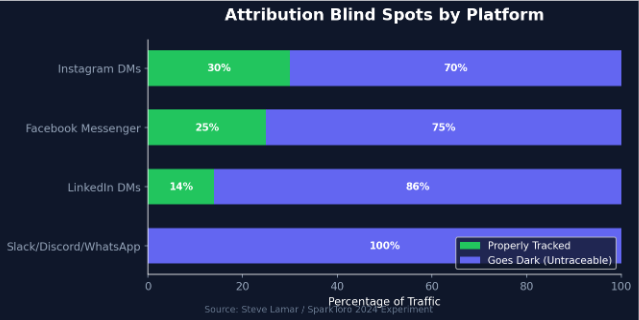
A 2024 experiment found that 100% of clicks from Slack, Discord, and WhatsApp show up as completely untraceable. LinkedIn only passes accurate referral data 14% of the time. Instagram? 30%.
Why Most Teams Are Missing It
Here’s the thing about marketing: we optimize what we can measure. And dark social, by definition, is hard to measure.
So instead, teams pour resources into the metrics they can see. They build dashboards around click-through rates, open rates, impressions, engagement, cost per acquisition, return on ad spend, bounce rates, time on page, and social shares. They run A/B tests to squeeze out incremental improvements. They write reports for leadership showing quarter-over-quarter gains on numbers that fit neatly into spreadsheets.
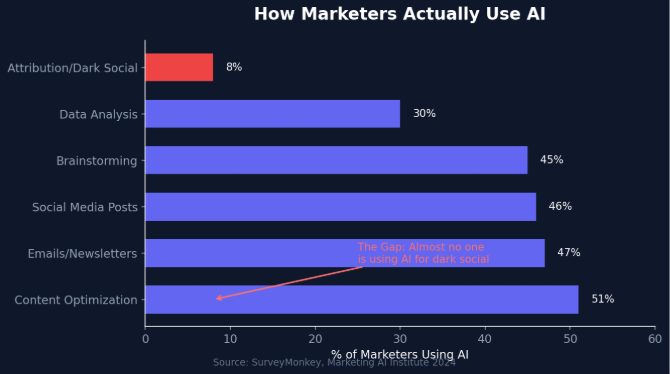
And increasingly, they’re pointing AI at these same metrics. According to recent data, 51% of marketers use AI for content optimization. 47% use it for emails and newsletters. 46% for social media posts. 45% for brainstorming. About 30% for data analysis and reporting.
In other words, most organizations are using the most powerful pattern-recognition technology in human history to get marginally better at the things they were already doing. They’re optimizing the visible minority while ignoring the invisible majority.
Why Dark Social Is Where Trust Lives
Here’s what makes dark social different from everything in your dashboard.
When someone shares your content publicly, they’re performing for an audience. When someone shares it privately, they’re making a recommendation to someone they actually know and trust. That’s a fundamentally different act with fundamentally different conversion implications.
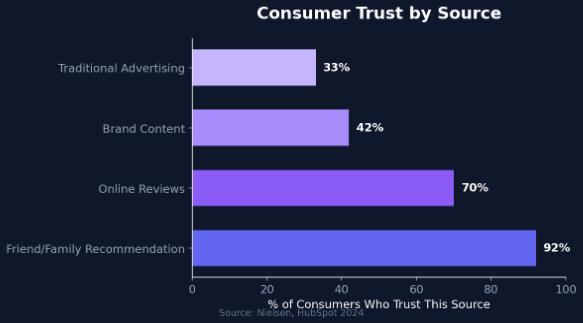
The data backs this up. According to Nielsen, 92% of consumers trust recommendations from friends and family over any other form of advertising. Word of mouth influences between 20% and 50% of all purchasing decisions. Referral marketing generates three to five times higher conversion rates than other channels. Customers acquired through peer recommendations have a 37% higher retention rate.
And here’s the number that should change how you think about your strategy: content shared through dark social channels converts at four to five times the rate of content shared on public platforms.
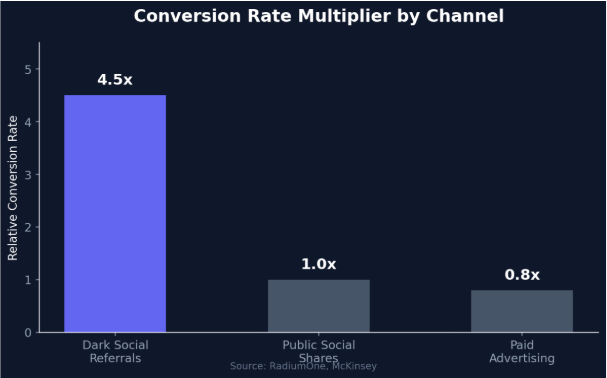
The channels you can’t see are often your most valuable ones.
The Behavioral Shift Accelerating This
Dark social isn’t just a measurement problem. It’s a behavioral shift that’s accelerating.
People are tired of being treated like algorithms. They’re exhausted by sponsored content, algorithmic feeds, and the performance of public posting. Instagram’s Adam Mosseri has called it "social media fatigue." Users are retreating into DMs, group chats, and closed communities where conversations feel authentic and they’re not being constantly tracked and targeted.
Discord is now the third most downloaded app on the App Store. Telegram’s user base grew 46% year over year. By the end of 2025, 65% of total mobile screen time is expected to be spent on social and messaging apps combined.
The public square is shrinking. The private room is expanding. And the gap between what dashboards show and what’s actually happening is getting wider every quarter.
How AI Changes the Game
This is exactly why AI has become central to how we approach growth strategy at BREATHE!.
Traditional tracking is fundamentally broken for dark social. UTM parameters don’t survive copy-paste sharing. Referral data doesn’t pass through encrypted messaging apps. Your pixel can’t see inside a group chat.
No amount of dashboard optimization will fix this because the problem isn’t efficiency. The problem is visibility. And AI pattern recognition is starting to crack it open.
Adobe Analytics’ 2024 platform update introduced AI-powered source recognition that correctly identifies up to 40% of previously uncategorized dark social traffic. It does this by analyzing traffic patterns, device information, time-of-visit clusters, and behavioral indicators. The algorithm doesn’t need referral data to infer where someone came from.
Salesforce’s research shows that marketers using advanced path analysis identify an average of 2.7 additional touchpoints per conversion compared to those using last-click attribution. Dark social touchpoints appear in 58% of B2C conversion paths and 43% of B2B paths.
AI attribution models don’t rely on the tracking mechanisms that dark social breaks. They use machine learning to analyze patterns across the entire customer journey, recognizing that the person who showed up as "direct traffic" probably didn’t type your URL from memory. They came from somewhere. And the algorithm can start to infer where.
This is why we’ve invested heavily in AI-powered analytics and attribution as part of our growth practice. It’s not about replacing human strategy, it’s about seeing the full picture so strategy can be built on complete information, not just the visible slice.
What This Means for Your Growth Strategy
If you’re running a brand and you’re not accounting for dark social, you’re optimizing for a world that’s disappearing.
A few things worth considering:
Redirect your AI investment. Stop using AI primarily to optimize traditional dashboard metrics and start using it for pattern recognition across your customer journey. The efficiency gains from better subject lines are marginal. The visibility gains from understanding dark social are transformational.
Treat your "direct traffic" as a signal, not a dead end. Most of it isn’t people typing URLs. It’s dark social. Analyze it. Segment it. Look for patterns in when and how it spikes relative to your other activity.
Create content worth sharing privately. The bar for private sharing is higher than public sharing. People don’t DM their friends mediocre content. They share things that make them look informed, helpful, or interesting. Build for that.
Just ask. Add "how did you hear about us" to your forms and intake calls. It’s low-tech, but research shows it can recover attribution for up to 30% of dark social traffic.
Invest in AI-powered attribution. The tools exist. The platforms are maturing. The question is whether you’re using them strategically or just bolting AI onto yesterday’s metrics.
The Bottom Line
We’ve spent the last decade building increasingly sophisticated ways to track the trackable. Meanwhile, the untrackable has been quietly eating the world.
Dark social isn’t a bug in the system. It’s how people actually share information with people they actually trust. It’s the internet working the way humans want it to work, not the way our attribution models need it to work.
AI won’t give you perfect visibility. But it will give you something better than pretending the problem doesn’t exist.
And that’s where real growth starts.
———
How BREATHE! Can Help
At BREATHE!, we are a strategic growth agency at our core, but we have the depth to serve as a creative agency, a consultancy, most importantly, a technology powerhouse. We help brands build growth strategies that account for the full picture, not just the metrics that are easy to measure.
Our AI-Powered Growth Services Include:
AI Attribution & Analytics – Implementing pattern recognition to uncover dark social influence and hidden conversion paths
Growth Strategy & Positioning – Building comprehensive strategies that connect brand, content, and performance
Content That Converts – Creating share-worthy content designed for private channels, not just public feeds
Marketing Technology Integration – Connecting your stack to surface insights traditional tools miss
Performance Marketing – Paid media strategy informed by complete attribution, not just last-click data
Ready to see the full picture?
Let’s talk about how AI-powered growth strategy can transform your marketing.
Get in touch: jen@breatheexp.com
Learn more: www.breatheexp.com
———
Strategic growth insights for brands that want to see the full picture.
© 2025 BREATHE!. All rights reserved.


Comments