
Your Next-in-Line Leaders Are Your Best AI Investment

Updated: May 4

The Leadership Layer That Will Decide Your Company's AI Future
Every discussion about Artificial Intelligence and Business Growth eventually lands on the same question: who, inside the organization, is going to make this happen? The CEO can set the vision. The board can approve the budget. The technology vendors can provide the tools. But the person who will actually build your company's AI capability — who will own the strategy, drive the adoption, close the data gap, install the governance, and connect AI investments to measurable outcomes — is almost never the CEO. It is the leader one level below. The VP who runs operations. The director who owns the customer-facing workflow. The high-potential team member who already thinks in systems and has been quietly experimenting with AI tools on their own. This is the leadership layer that will determine whether your company's AI ambitions produce results or remain permanently on the agenda.
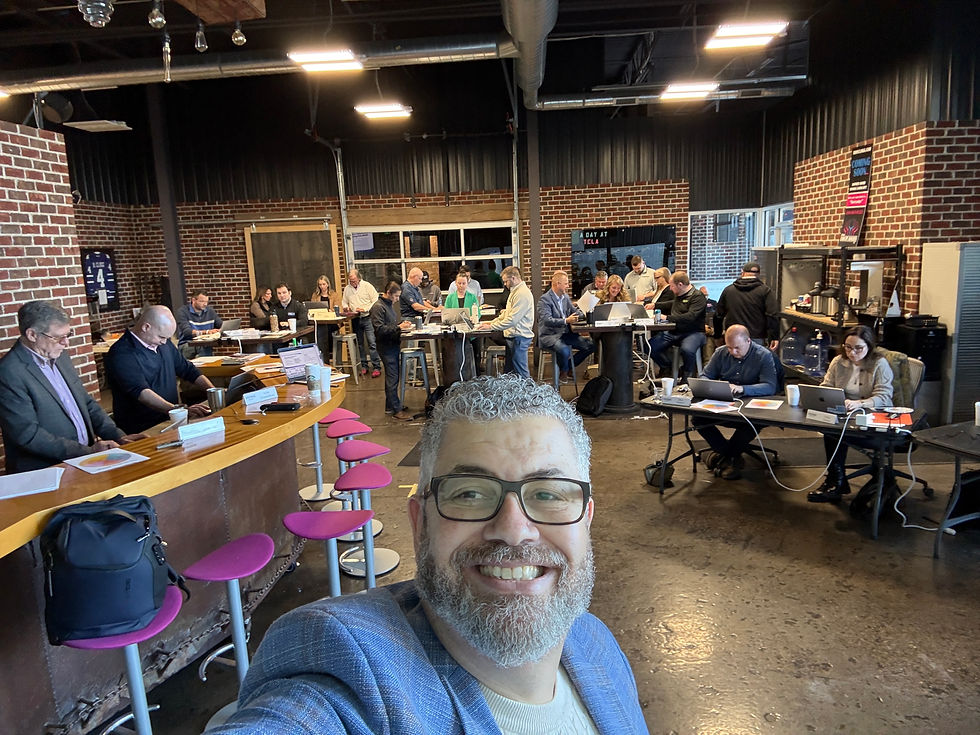
On April 17, 2026, a CEO advisory group workshop was delivered in Vancouver, British Columbia — and what made the session notable was not just the content covered or the industries represented. It was the profile of the people in the room. Every single respondent was a VP, director, or senior operational leader. Not a CEO or business owner in the survey data. A room of exactly the leaders that CEOs should be investing in for AI development — and a room that revealed, with unusual clarity, both the potential of that investment and the specific gaps that need to be closed to realize it.
What Five Vancouver Leaders Revealed About the Next-Gen AI Gap
The Vancouver session brought together leaders from manufacturing, HVAC industrial and commercial service, modular construction, executive leadership development, and mechanical construction. Five companies. Three concentrated in the construction and trades sectors. A group of VPs and directors who are, in most cases, the people their CEOs are counting on to execute the AI agenda — without necessarily having been given the framework, the authority, or the development needed to actually do it.
The survey data from this group is instructive precisely because of the role level. These are not leaders who lack technical exposure or strategic awareness. They are leaders operating inside the accountability gap that defines AI adoption in most mid-market organizations — where the intent to build AI capability lives at the top and the execution pressure falls on the middle, without the connecting infrastructure of strategy, governance, and ownership that makes execution possible. Here is what their data showed:
60% had no single accountable owner for AI outcomes. Three of five respondents had no clear owner — either no one designated at all, or a working group with collective responsibility and therefore diffuse accountability. In an execution-focused group of directors and VPs, this absence of named ownership is the most direct explanation for why pilots stall and strategies stay theoretical.
80% had no formal KPI accountability tied to AI. 40 percent had no KPIs at all, and another 40 percent were tracking results occasionally with no named owner. Only one company in the room had a structured AI accountability framework with a KPI, an owner, and a review cadence — and that company was also the furthest ahead on every other AI readiness dimension.
60% had no effective AI safety governance. Three respondents were relying on informal habits with no consistent enforcement. In industries where subcontractor data, client specifications, project financials, and proprietary design information flow through digital systems daily, informal AI governance is a genuine liability — not an oversight, but a gap that needs to be closed before AI adoption scales.
60% named talent and skills as their biggest blocker. The leaders in the room who most need to develop AI expertise named the absence of that expertise as their primary barrier. This is not a contradiction — it is a call to action. The talent gap is not filled by waiting for the market to produce AI-literate candidates. It is filled by developing the leaders who are already inside the organization.
40% named talent development as their primary AI goal. Alongside cost reduction at 40 percent and revenue growth at 20 percent, the Vancouver group's focus on using AI to address workforce capability gaps reflects the specific challenge facing construction and trades businesses: the acute shortage of technical talent that cannot be solved through traditional hiring alone.
80% said they want to learn about developing an internal AI leader. Four of five respondents — VPs and directors themselves — indicated they want information about building internal AI leadership capability. This is a striking data point: the people who should be developed as AI leaders are actively seeking that development. The gap is not motivation. It is access to the right program.
AI confidence averaged 6.6 out of 10, ranging from 5 to 8. The leader at an 8 — Ian Scott-Kerr from Nicholson Manufacturing — had already achieved what the others were working toward: clean, labeled data with access controls, a best-practice AI safety framework with activity logging, 1 to 2 pilots in production, and a functioning KPI structure with a named owner. The distance between his profile and the rest of the group was not luck or resources. It was the presence of organizational structure — and the absence of that structure in the other four companies is precisely what the GPS Summit is designed to build.
What the Vancouver Data Teaches CEOs About AI Investment
The Vancouver session is unique in the GPS Summit series for a reason that goes beyond geography or industry mix. It is a session where the people in the room were not the business owners or primary decision-makers — they were the executors. The VPs and directors who will be held accountable for AI results even if they were not the ones who approved the AI agenda. And their data reveals something every CEO should take seriously: the leaders you are counting on to deliver AI outcomes are motivated, engaged, and explicitly asking for the development that would enable them to do it.
The Company That Already Got It Right
Ian Scott-Kerr from Nicholson Manufacturing arrived at the Vancouver session with something none of the other four respondents had: a complete, functioning AI readiness foundation. Clean, labeled data with proper access controls. Sensitive customer and company data blocked from AI tools, with activity logged and reviewed. Pilots in production. A KPI with a named owner and a review cadence. A confidence score of 8 out of 10.
What is instructive about Ian's profile is not just that it represents best practice — it is that he is a VP, not a CEO. A functional leader who has been given the mandate, the tools, and the organizational authority to build real AI capability from within the company. Nicholson Manufacturing's competitive position on AI is not a result of their CEO being more AI-savvy than other CEOs. It is a result of their CEO developing a leader who is.
This is the model that every business represented in the Vancouver room needs. Not a CEO who personally manages the AI agenda on top of every other responsibility. A developed, empowered VP or director whose specific job it is to own AI outcomes, build the infrastructure, and deliver results. Ian represents exactly what that looks like — and the four companies whose data fell significantly short of his profile are the four companies whose leaders most need what the GPS Summit delivers.
Leadership Buy-In From Below: The Overlooked Adoption Challenge
One of the Vancouver respondents named leadership buy-in as their biggest AI blocker — and from a VP or director, this answer means something specific and important. When a senior operational leader says leadership buy-in is the problem, they are almost never talking about their own buy-in. They are describing a situation where they can see what needs to be built, they have the motivation to build it, and the organizational authority to do so is not yet in place. The budget is controlled elsewhere. The strategic priorities are set above them. The organizational commitment to AI is not yet clear enough to give them the mandate to move.
This is one of the most important and underappreciated dynamics in mid-market AI adoption. When the leadership layer below the CEO understands AI's potential and wants to build but lacks the organizational alignment to proceed, AI capability stays stuck regardless of the tools available or the individual motivation present. The GPS Summit addresses this directly — not just by developing the leader's AI skills, but by equipping them to build the business case that secures the buy-in they need from the level above them. Speaking the language of revenue, cost reduction, and Competitive Advantage rather than the language of technology is what converts a capable VP into a sponsored AI champion.
AI and the Talent Challenge in Construction and Trades
Three of the five Vancouver respondents came from construction and mechanical trades — modular construction, HVAC, and mechanical contracting. This sector concentration mirrors what the GPS Summit series has seen repeatedly: construction and trades businesses are among the most motivated to use AI for workforce and talent development, and among the most underserved by the mainstream AI conversation.
The talent shortage in construction is structural and long-term. Skilled trades workers are retiring faster than they are being replaced. Technical training pipelines are constrained. And the operational complexity of managing subcontractors, project schedules, safety documentation, client communications, and regulatory compliance creates an information management burden that consumes capacity at every level of the organization.
AI addresses each of these challenges in ways that are specific, practical, and immediately deployable. It can capture and codify the technical knowledge of experienced tradespeople before they retire — creating training assets that accelerate the development of new hires. It can automate the documentation burden — safety checklists, change orders, project updates, client reporting — that currently pulls skilled project managers away from the complex coordination work that actually requires their expertise. And it can improve Customer Experience by making communication more consistent, timely, and informative throughout the project lifecycle. For construction businesses where reputation and referral are the primary growth drivers, this Customer Engagement improvement has direct revenue implications.
When the Data Gap Is the Starting Point, Not the Obstacle
Three of the five Vancouver respondents described their data as either scattered and siloed or raw and unlabeled. In the context of a group that named cost reduction and talent development as primary AI goals, this data gap is not just an obstacle — it is the starting point. Because the first valuable AI use cases for many construction and service businesses live precisely in the process of organizing and making sense of their existing data.
Building a data inventory, cleaning and labeling operational records, establishing access controls, and creating the pipeline through which operational data flows into AI tools — this is not glamorous work, but it is foundational work that produces Customer Insights, operational insights, and Digital Transformation results that are impossible to achieve on scattered, siloed data. The company that completes this foundation — especially in a sector like construction where most competitors have not — holds a durable Competitive Advantage that extends well beyond any individual AI tool deployment.
The GPS Summit: Built for the Leaders the Vancouver Room Represents
The Vancouver session is, in many ways, the most direct illustration of what the GPS Summit is designed to address. Five high-potential VPs and directors, four of whom want to learn how to develop internal AI leadership, sitting in a room and engaging seriously with the gap between their current AI capability and the outcomes they are trying to produce. This is not a group that needs convincing. It is a group that needs a program.
The GPS Summit was built for exactly this profile. Not for CEOs who want to understand AI at a high level — for the VPs, directors, and high-potential operational leaders who will be handed the AI mandate and need the strategy, the governance tools, the KPI frameworks, and the peer accountability structure to carry it out successfully.
Here is what GPS Summit participants are equipped to deliver:
A complete, ownership-ready AI Strategy — not a plan that lives in a deck, but a living roadmap with named owners, sequenced use cases, and KPIs that make AI performance as visible and accountable as any other operational function.
AI governance frameworks for complex, regulated environments — including the data access controls, sensitive data protection policies, and activity logging standards that allow AI to be deployed safely in construction, HVAC, and other industries with significant data sensitivity requirements.
Applied AI in talent development and operational efficiency — deploying AI to close workforce gaps, accelerate technical training, automate documentation burden, and free the human team for the complex, relationship-intensive work that drives project success.
Customer-facing AI capability — applying AI to Customer Experience design, Customer Engagement automation, AI in Marketing execution, and Customer Insights generation that improve client retention and referral growth.
The organizational credibility to secure leadership buy-in — presenting AI initiatives in business terms that move CEOs, boards, and budget holders from passive support to active sponsorship, giving the AI leader the mandate to actually execute.
To learn more about the GPS Summit and how it develops the VPs and directors who will lead your company's AI future, visit the GPS Summit overview page or review the full competitive comparison.
The Leaders Who Want to Build Are Already on Your Team
Eighty percent of the Vancouver respondents — VPs and directors who showed up to a CEO advisory group workshop and engaged honestly with their company's AI readiness — said they want to learn more about developing internal AI leadership. Not someday. They filled out the form. They want the information now.
That response rate is not a statistic. It is a signal from the leadership layer of your organization. The people who will be executing your AI strategy are not waiting for permission to care about it. They are already motivated. They are already looking for the right framework, the right program, and the right support to move from the muddled middle — where 80 percent of their peers in Vancouver had no formal AI accountability — to the structured, producing, compounding capability that one company in that room had already built.
The GPS Summit is that program. It is built for Ian Scott-Kerr's peers — the operational leaders who have not yet had the development that Ian's employer invested in, but who are ready for it, asking for it, and will make exceptional use of it when it is provided. The Competitive Advantage that Nicholson Manufacturing has built on AI readiness is not a proprietary technology. It is a developed person. And developing that person, in your company, is a decision that is available to you right now.
When you are ready to invest in the leader who will build your company's AI future from the inside out, enroll them in the GPS Summit here. To learn more about BREATHE! Experience and the full program, visit breatheexp.com.
Who is the VP or director inside your organization right now who has the instincts, the motivation, and the potential to build your company's AI future — and what would change if you gave them the framework and the mandate to actually do it?


Comments