
71% Have No AI Owner. Here Is Why That Number Matters.

The Single Organizational Decision That Determines AI Success
Every significant technology shift in modern business history has had the same dynamic at its core: the companies that moved early and decisively built advantages that were very difficult for late movers to close. This is not a theory. It is a pattern that has played out across the internet economy, cloud computing, mobile commerce, and now Artificial Intelligence. The businesses sitting at the top of every major industry a decade from now will not necessarily be the ones with the most capital or the most established brand. They will be the ones that, right now, are making the organizational decisions that compound into durable Competitive Advantage over time.
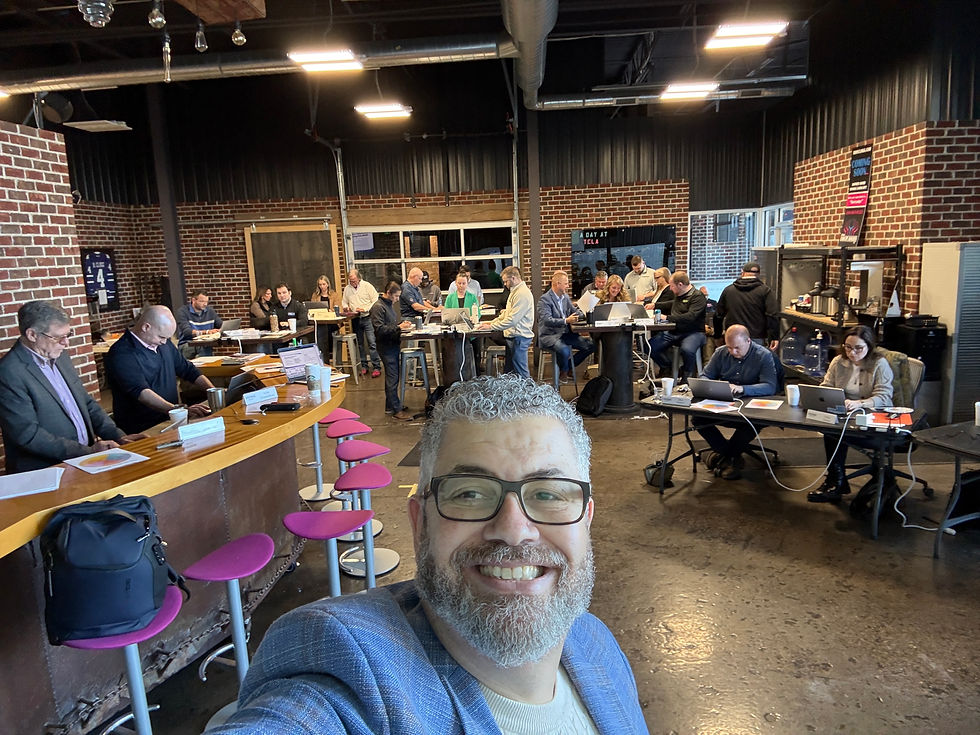
The most important of those decisions is deceptively simple: who owns AI inside your company? Not in a nominal sense. Not as a line item on the CEO's already overloaded plate. As a dedicated, empowered, accountable role whose purpose is to move your organization's AI Strategy from conversation to production. On March 12, 2026, a CEO advisory group gathered in Detroit, Michigan for an AI workshop that produced one of the starkest data sets of the GPS Summit series. Twenty-eight business leaders. Sixteen different industries. And a number that defines the challenge with total clarity: 71 percent of the attendees in that room had no clear owner for AI outcomes anywhere in their organization.
That number is not a criticism of the people in the room. It is a description of where most mid-market companies currently stand — and a clear signal of the opportunity that still exists for the businesses willing to act on it now.
What 28 Detroit Business Leaders Revealed About AI Readiness
The March 12 Detroit session drew one of the largest and most diverse groups of the GPS Summit series to date. Represented industries spanned landscaping, snow removal, manufacturing, insurance, filtration, staffing, immigration law, workplace learning design, public accounting, sales consulting, nonprofit charitable organizations, and technology. These were companies ranging from under 50 employees to over 1,000. The common thread was not industry or size. It was the consistent gap between where these organizations understood they needed to be on AI and where they actually were.
The survey data tells the story directly:
71% had no clear owner for AI outcomes in their business. This was the defining data point of the session. Nearly three quarters of the room — across industries, company sizes, and revenue levels — have not made the fundamental organizational decision that makes everything else possible.
64% had zero AI or automation pilots in production. An additional 7 percent had paused their pilots entirely — meaning nearly three quarters of respondents have no live AI deployment generating real business outcomes today.
79% had no KPIs tied to AI outcomes. Without measurable accountability, there is no mechanism to assess whether AI investments are working, where to double down, or when to change course. Almost four in five organizations in the room are flying blind on AI performance.
61% had no AI safety protections in place at all. In a room spanning law firms, insurance companies, healthcare-adjacent businesses, and financial services, more than six in ten organizations have zero governance framework governing how their teams use AI tools or what data they feed into them.
61% named talent and skills gaps as their single biggest blocker. This was the dominant answer by a significant margin, outpacing data quality, budget, leadership buy-in, and technology stack concerns combined.
57% identified revenue growth as their primary goal for AI. An additional 18 percent named improved Customer Experience as their top AI outcome — meaning three quarters of the group's most important AI goal is directly tied to the two outcomes that AI has the highest documented impact on when properly deployed.
Confidence in their company's AI competitiveness by 2027 averaged 6.6 out of 10 across the group, with scores ranging from a sobering 1 to a confident 10. That spread reveals something important: the leaders at the lower end of the range were not there because they were passive or uninformed. They were there because they could see clearly how much ground needs to be covered and had not yet found the path to cover it.
"This was probably the most impactful and meaningful training I have had in my 18 years with Reliance One. Cannot thank you enough!!" — Kevin G., Reliance One Inc.
Kevin's response captures something that comes up repeatedly in CEO advisory groups where this workshop is delivered: the gap between what most business leaders have been told about AI and what they actually need to know to act on it is enormous. The language in the market is full of hype and abstraction. What leaders need is clarity — about where they are, what the gap is, what the path forward looks like, and who needs to walk it. That clarity is what changed for Kevin. And it is what the GPS Summit delivers.
What the Data Points to and What You Can Do About It
The March 12 Detroit data does not describe a group of companies that are behind on AI because they lack the will or the intelligence to move forward. It describes a group of companies that are behind because they have not yet solved one foundational problem: the absence of dedicated, empowered, accountable AI Leadership. Every other gap in the data — the absent KPIs, the stalled pilots, the missing governance, the data chaos — traces back to that single organizational vacancy. Fill it, and everything else becomes solvable. Leave it unfilled, and the other investments stay stuck.
Why 71 Percent Without an AI Owner Is the Root Cause
When no one owns AI, AI does not move. This is not a management theory — it is basic organizational physics. Every meaningful initiative that produces results inside a company has someone whose name is on the outcome. Sales has a VP. Finance has a CFO. Operations has a director. But AI — the capability that will determine whether your company can compete on customer experience, whether your marketing engine can generate Customer Insights at scale, whether your Digital Transformation actually produces a return — is owned by everyone and therefore owned by no one.
The companies in the Detroit room with the highest AI confidence scores, the most pilots in production, and the only measurable KPIs attached to AI outcomes shared one characteristic: they had a named person or a functioning team with real accountability for AI results. That is not a coincidence. It is cause and effect. And for the 71 percent of the room still operating without that structure, the decision is not whether to build AI capability — every leader in that room knew they needed to. The decision is who gets the mandate to build it and how quickly they can be equipped to execute.
The Revenue Goal That AI Is Already Positioned to Deliver
Fifty-seven percent of the March 12 group named revenue growth as their primary AI outcome. This is the right goal, and it is one that AI is exceptionally well positioned to deliver — through smarter Customer Engagement, more targeted AI in Marketing execution, better Customer Experience design, and the kind of Customer Insights that allow companies to make faster, sharper decisions about where to invest sales and marketing resources.
But revenue growth from AI does not happen because a company subscribes to an AI tool. It happens because someone inside the organization understands how to connect AI capabilities to specific revenue levers — which customer segments to prioritize, which touchpoints to automate, which data sets to combine to reveal patterns that the human eye misses, and which marketing channels become dramatically more efficient when AI is optimizing them in real time. That knowledge does not come from a tool. It comes from a person. And developing that person is precisely what the GPS Summit is designed to do.
"We need to automate some of our processes and then improve the client experience." — Domenic R., MKGPC
Domenic's comment from the public accounting space reflects a pattern that shows up across every industry in the GPS Summit series. The two things most companies want from AI — process automation and client experience improvement — are not separate goals. They are the same goal. When you automate the repetitive, time-intensive internal processes that consume your team's capacity, you free them to deliver the kind of attentive, high-value client experience that builds loyalty and drives referral growth. AI does not choose between operational efficiency and Customer Experience. When implemented correctly, it delivers both simultaneously.
The Governance Problem That Compounds Every Other Risk
Sixty-one percent of the March 12 Detroit group had no AI safety protections in place at all. For a room that included attorneys, insurance professionals, and financial service providers, this is a significant exposure. But it is not an unusual one. Across the GPS Summit series, the absence of AI governance is the norm rather than the exception among companies that have not yet deployed AI at scale.
The risk is real and multidimensional. Without a governance framework, team members may be feeding sensitive client data into public AI tools with no visibility into where that data goes. Outputs from AI tools may be going into client-facing work without adequate review. And when something goes wrong — a data breach, a compliance issue, a client trust violation — there is no audit trail and no accountability structure to contain the damage. This is not a reason to avoid AI. It is a reason to build the governance infrastructure that makes AI safe to scale.
The GPS Summit addresses this directly, giving participants the frameworks to establish data access controls, usage policies, output review protocols, and the internal culture of responsible AI adoption that allows companies to accelerate rather than be slowed down by legitimate security concerns.
"Our charity is 100% volunteer run which is great for getting the most dollars direct to families in need, but results in disjointed back-end processes often without an owner." — Kelsey W., Hot Pink Helpers
Kelsey's reflection from her work with Hot Pink Helpers — a cancer support charity operating entirely on volunteer capacity — is one of the most revealing comments of the session precisely because of its context. If a 100 percent volunteer-run organization can see the path to using AI for Business Growth and operational sustainability, the argument that AI is too complex or too resource-intensive for any organization dissolves completely. The starting point she described — streamlining QuickBooks, payment links, receipts, and email workflows — is exactly the kind of grounded, practical AI entry point that creates real efficiency, frees human capacity for mission-critical work, and builds the organizational momentum that leads to more advanced AI adoption over time.
The GPS Summit: Built for the Room That Showed Up in Detroit
Every person in that Detroit room on March 12 — from the landscaping operator to the immigration law firm director to the insurance executive to the nonprofit treasurer — was sitting at the same inflection point. They understood that AI is not optional. They felt the urgency to move. And they were each wrestling with the same foundational question: how do we build this capability inside our organization in a way that actually produces results?
The GPS Summit was built to answer that question — not in the abstract, but through a structured development experience that produces a real organizational outcome: a trained, empowered, accountable AI Leader inside your company who can own the strategy, drive the execution, and deliver the business growth results that every leader in that room said they are after.
GPS Summit participants develop the capability to:
Define and own a complete AI Strategy — including use case prioritization, KPI development, resource planning, and a 90-day execution roadmap tied to specific business growth outcomes.
Apply AI to revenue and customer outcomes — including AI in Marketing, Customer Engagement personalization, Customer Experience redesign, and Customer Insights generation that improves decision quality across the business.
Build AI governance from the ground up — establishing the data protection policies, usage guidelines, and accountability structures that allow safe, scalable AI adoption regardless of industry.
Drive Digital Transformation across the organization — building the internal credibility, cross-functional relationships, and change management skills needed to move AI from pilot to production to competitive advantage.
Operate as part of a peer learning cohort — working alongside emerging AI leaders from non-competing industries who are navigating the same organizational challenges and building the same capabilities.
Learn more about the program and what sets it apart at the GPS Summit overview page, or review the full competitive comparison to see exactly how this program stacks up against other leadership development options in the market.
The 29th Person in That Room Was Not There Yet
Every leader who sat in that Detroit room on March 12 had one thing in common beyond their survey responses: they showed up. In a culture that generates an endless supply of reasons to defer the hard decisions, these were the leaders who carved out the time, walked into a room of peers, and engaged honestly with where their company stands on AI. That kind of self-awareness and willingness to assess reality clearly is the first requirement for building something real.
But showing up to a workshop is not the same as building an AI Leadership capability. The distance between a powerful session and a permanent organizational change is exactly the distance that the GPS Summit is designed to close. The insights from a morning session become the strategy framework for the next three years. The urgency felt in the room becomes the accountability structure that keeps execution moving. And the person who walked in as your most promising high-potential leader walks out as the internal AI champion your company has been waiting for.
The Competitive Advantage available to companies that build this capability now is not modest. It is structural. Every month that passes without a named, equipped, accountable AI leader inside your organization is a month that your competitors who made that decision are compounding their lead. The AI gap that exists in your market right now will not stay open indefinitely. The window to build a meaningful, durable advantage is real — and it will not be open forever.
When you are ready to enroll your highest-potential leader and give them the foundation to own your company's AI future, enroll them in the GPS Summit here. To learn more about BREATHE! Experience and the mission driving the GPS Summit program, visit breatheexp.com.
How different would your company's AI position look in 2027 if you made the decision today to name, develop, and empower the right internal leader to own it?


Comments