
Vancouver, OR: Building Momentum for AI-Driven Growth


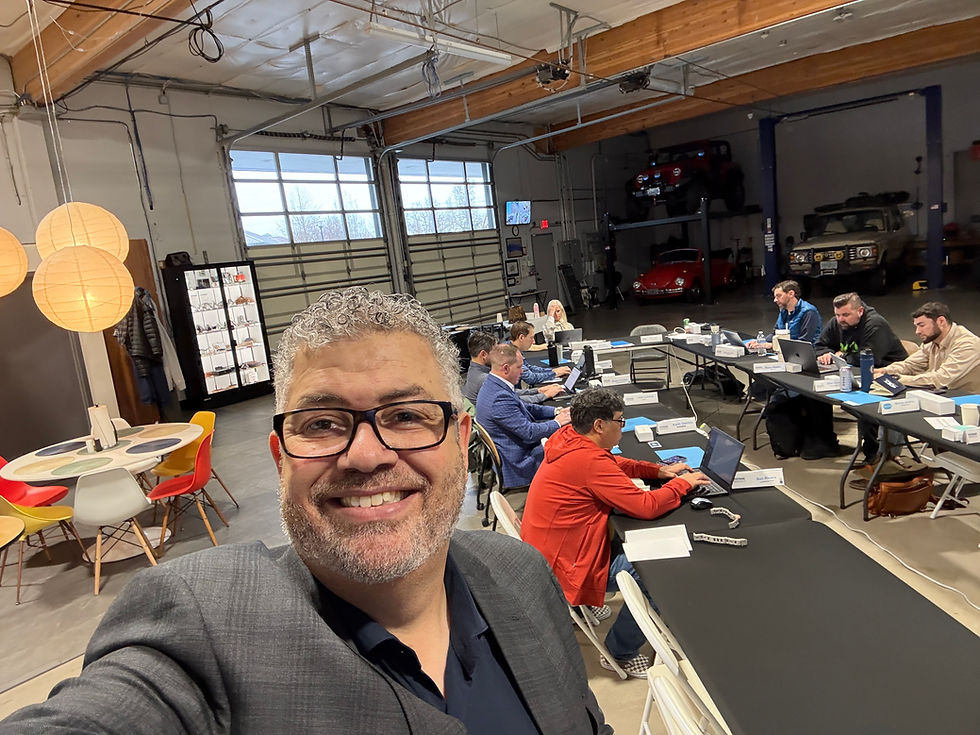
Vancouver, Oregon, September 18, 2025 — AI Isn't Coming—It's Here
For years, businesses debated when AI would make a difference. The reality, as leaders in Vancouver, Oregon discovered, is that the question is no longer "when," but "how." AI has transformed the competitive landscape. Organizations that align it with strategy and execution create disproportionate advantages.
With perfect scores across content, deliverability, applicability, and recommendation, this session proved business leaders are hungry for practical, real-world application. One participant captured it: "Extremely relevant and helpful, real world applications!"
Engaged, Energized, and Challenged: Participant Reflections
The Vancouver group's reviews reflected excitement, urgency, and newfound perspective.
"Great presentation on AI. Especially for those who are skeptical of it."
"Really highlights the power of AI Agents and what is possible when you use AI Agents to automate workflows."
"This was an eye-opening meeting to show the ability of AI agents to 10x in our company."
"Very timely and useful information."
Even participants who entered uncertain about AI's role left with structural clarity and conviction.
Ownership, Agility, and the Leadership Gap
Survey responses revealed crucial tension: while many attendees recognized AI's transformative potential, few had clear implementation plans. In some organizations, the CEO or GM had stepped into this role, but most reported either no owner or only loosely defined working groups.
This leadership gap is critical. Without an accountable champion, AI remains a "side project" rather than strategic driver. Alignment and accountability are non-negotiable. If leadership doesn't claim ownership, execution falters.
Agility was another concern. When asked how quickly teams could respond to a 15% performance drop, answers varied:
Some could pivot within the same day or week
Others admitted it might take a month, quarter, or crisis to force change
This inconsistency reveals the cost of unclear processes and siloed decision-making. AI, when tied to real-time data and monitored against KPIs, provides the responsiveness businesses need.
Data and Safety: Current Readiness State
Organizational readiness to launch AI pilots painted a familiar picture:
Several had only scattered or siloed data exports
A handful reported raw data that could be labeled
Only one or two had clean, labeled datasets with access controls
Data quality emerged as one of the most common blockers, alongside talent shortages, budget concerns, and tech stack limitations.
Regarding AI safety, most organizations had some rules but admitted partial enforcement. A few had robust protections—blocking sensitive data from entering AI tools and logging activity—while others had no protections.
This reflects broader industry truth: businesses are eager to adopt AI but often neglect governance structures necessary to sustain trust and scale.
KPIs, Outcomes, and Blockers
When asked about current KPIs tied to AI, the majority admitted they had none. A small number tracked results occasionally without ownership. Only a couple had clear KPIs, named owners, and review cadence.
This lack of measurement makes scaling AI nearly impossible. Success without accountability is accidental. With accountability, it becomes repeatable.
Desired outcomes:
Revenue growth
Cost reduction
Customer experience improvements
Closing talent and skills gaps
Blockers:
Data quality
Talent shortages
Budget limitations
Lack of leadership buy-in
This combination reveals both opportunity and urgency. Leaders want AI to solve pressing challenges, but without clarity on ownership, data readiness, and skills, adoption stalls.
The Learning Moment: AI as Path to Confidence
One key insight: AI doesn't need to be overwhelming. It doesn't require perfection or massive infrastructure to start. Leaders left understanding the path forward is about small, intentional pilots tied to clear KPIs, supported by leadership, and informed by positioning.
One attendee shared: "Great content. I hope this helps me have more confidence in using AI and building agents to move the company forward, while increasing revenues and decreasing costs."
Another asked the right question: "What are the skills needed to drive this AI program toward using digital employees and resources?" Organizations aren't just considering tools—they're considering capability, culture, and sustainability.
Where Will You Claim Ownership?
The Vancouver session made one truth undeniable: AI is no longer optional, but adoption without alignment is ineffective. Leaders who commit to ownership, invest in data readiness, and tie AI efforts to clear KPIs will unlock cost savings, growth, and customer loyalty.
The question becomes: Where in your business will you take ownership of AI today—and how quickly will you move from experimentation to execution?
Where GPS Summit Creates Internal AI Leaders
This workshop revealed something critical: leaders don't just want AI exposure. They want internal capability they can install inside their companies. They want AI leadership that moves work from experimentation to execution with precision and discipline.
That's what GPS Summit delivers.
GPS Summit transforms high-potential employees into AI Systems Generalists in three days—faster than MIT's 8-week program, more practical than Stanford's $18K certificate, designed for companies that need internal capability, not consultant dependence.
Your designated leader learns to identify bottlenecks, build solutions, and drive measurable efficiency gains within a 90-day roadmap. Applied learning that creates force multipliers.
The result: internal leaders who turn your organization's AI initiatives from scattered experiments into repeatable competitive advantage.
Ready to develop your internal AI leader?Enroll your high-potential employee in GPS Summit
Next Steps
The organizations that answer "who will own our AI strategy" with structural clarity and speed to competency will not just adopt AI—they will leverage it for measurable growth while competitors remain stuck in experimentation.


Comments