
Why American Manufacturing Has the Most to Gain from AI

Updated: May 4

The Sector With the Most to Gain — and the Most Ground to Make Up
American manufacturing has always been defined by precision, durability, and the relentless drive to produce more with less. These are not just operational virtues — they are competitive ones. And right now, the industry that built this country's economic backbone is sitting at the most consequential technology inflection point it has faced in a generation. Artificial Intelligence is not a software company phenomenon or a Silicon Valley priority. It is a manufacturing imperative — and the GPS Summit session in Chicago on April 14, 2026 delivered the clearest evidence yet of both the urgency and the opportunity.
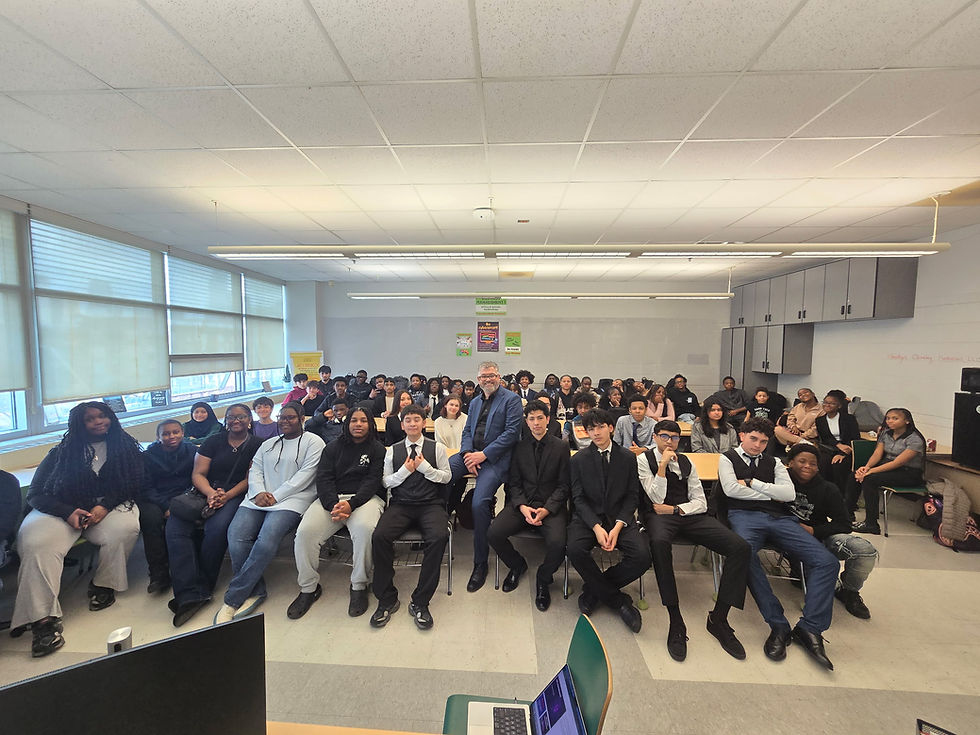
Nineteen business leaders gathered that morning, representing industries spanning aluminum castings, die manufacturing, industrial plating, hydraulic fittings, bulk material handling, packaging, oil and gas, aviation, health benefits, and consulting. Sixty-eight percent of the room came from manufacturing and industrial operations. The session earned a perfect 5 out of 5 across all three rating categories — Quality of Content, Quality of Delivery, and Applicability — and a 100 percent recommendation rate. Back-to-back perfect scores in consecutive sessions now, and the feedback from Chicago goes well beyond satisfaction. It reflects something more significant: a room full of people who walked in uncertain about AI and walked out genuinely excited about what they could build.
What 19 Chicago Leaders Revealed About AI in the Industrial Heartland
The Chicago data set is one of the largest and most revealing in the GPS Summit series — nineteen respondents, a strong concentration of manufacturing and industrial companies, and a confidence profile that was notably higher than many previous sessions. The average AI confidence score was 7.7 out of 10, with 53 percent of respondents rating themselves at an 8 or higher. Several leaders had already completed multiple pilots and established formal KPI structures. But the readiness gaps that define the broader market were still clearly visible beneath that confidence:
68% had zero AI pilots in production. Despite higher average confidence, more than two thirds of the group had not yet moved a single AI initiative from experimentation into live deployment. Confidence in the concept of AI does not automatically translate into deployed capability.
84% had no formal KPI structure tied to AI outcomes. 47 percent had no KPIs at all, and another 37 percent were tracking results occasionally with no named owner. Only 16 percent — three companies in the room — had a clear AI use case with a KPI, an owner, and a regular review cadence.
84% had no effective AI safety governance. 63 percent had zero protections in place, and another 21 percent relied on informal habits with no consistent enforcement. In a room that included oil and gas, aviation, and healthcare-adjacent businesses, the governance gap is a significant liability.
68% named talent and skills gaps as their biggest AI blocker. For the thirteenth time across the GPS Summit series, talent dominates the blocker category by a wide margin. This is no longer a data point — it is a defining characteristic of where the mid-market currently stands on AI adoption.
32% named talent development as their primary AI goal. Alongside the 37 percent seeking revenue growth, this was a standout finding from Chicago: nearly a third of leaders came in focused not just on what AI can do for their operations, but on what AI can do to help them attract, develop, and retain the skilled people their businesses depend on. In manufacturing, where the workforce gap is one of the most pressing long-term challenges in the sector, this framing is both prescient and practical.
"Good intro to integrating AI into your business. Showed how it should not be scary." — Chicago Workshop Attendee, April 14, 2026
This comment captures the emotional starting point that most manufacturing and industrial leaders bring to AI conversations. Fear — not of the technology itself, but of the unknown, the disruptive, and the potentially overwhelming. What the Chicago session demonstrated is that when AI is introduced through real-world examples, with practical frameworks and an honest assessment of where to start, that fear dissolves quickly. It is replaced by something more productive: curiosity, momentum, and the specific kind of excitement that Aaron Pifer from Header Die and Tool captured in his own words.
"I thought this experience was exciting and great. I learned a lot and I am excited for what we can dream and come up with." — Aaron P., Header Die and Tool
Aaron's response is the one that matters most for manufacturing leaders who are still on the fence about AI. He did not walk in as a technology enthusiast. He walked in as someone doing his job in a manufacturing environment who sat through a session and left genuinely energized about the possibilities. That shift — from uncertainty to active imagination about what could be built — is what the GPS Summit is designed to produce at every level of an organization, not just in the C-suite.
The AI Opportunity Hiding Inside American Manufacturing
Manufacturing has unique characteristics that make it one of the highest-opportunity sectors for AI adoption — and one of the most complex to navigate. The data richness is extraordinary: process parameters, equipment performance, material inputs, quality outputs, supplier metrics, customer delivery records, and workforce productivity data all exist in most manufacturing environments at a scale that most service businesses can only dream of. When that data is organized and made accessible to AI tools, the Customer Insights, operational insights, and predictive capabilities that emerge are transformational.
From Data Rich to Decision Fast
One of the most telling survey questions in the GPS Summit series asks how quickly a company can make a production change when a key performance number drops by 15 percent. In Chicago, the responses spanned the full range — from same day to within a week to within a month or quarterly. The leaders who can respond same day or within a week share a characteristic: they have already invested in the information infrastructure that makes rapid decision-making possible. They know what their numbers mean, they know how to move them, and they have the organizational alignment to act without delay.
AI accelerates this capability dramatically. When machine learning models are monitoring production parameters in real time, flagging anomalies before they become defects, predicting maintenance needs before they become downtime, and surfacing patterns that human operators would take days to identify manually — the company's response speed to any performance signal compresses from weeks to hours. For manufacturers competing on quality, delivery, and cost, this compression is not a marginal improvement. It is a structural Competitive Advantage that is extremely difficult for competitors to replicate once it is built.
Using AI to Win the Workforce Challenge
The fact that 32 percent of the Chicago group named talent development as their primary AI goal is worth examining carefully — because it reflects a sophisticated understanding of AI's role in the workforce that goes well beyond the fear-driven automation narrative. In manufacturing, the skilled workforce challenge is real and long-term. Baby Boomer retirements are accelerating, technical training pipelines are under-resourced, and the competition for skilled operators, technicians, and engineers is intense across every region of the country.
AI addresses this challenge from multiple angles simultaneously. It can capture and codify the institutional knowledge held by experienced workers before they retire — creating training assets, process documentation, and decision support tools that transfer expertise to new team members faster than traditional apprenticeship models. It can personalize training programs to individual skill gaps, accelerating development timelines. And it can handle the routine, documentation-heavy work that consumes skilled workers' time, freeing them to focus on the complex problem-solving and relationship management that actually requires their expertise. Used this way, AI is not a threat to manufacturing employment — it is a strategy for protecting and developing the workforce that manufacturing runs on.
The Three Companies Already Doing It Right
Three of the nineteen Chicago respondents had already reached the organizational state that the GPS Summit is designed to build toward: three or more pilots in production, a clear KPI with a named owner, and a regular review cadence. PBC Linear, represented by both Tom Schroeder and Ethan Kinney, was among them — a manufacturer that has clearly made the organizational decisions that most of their peers are still working toward. The data from these three companies is instructive not because they are outliers but because they illustrate exactly what is possible and what it looks like when the structure is in place.
"A lot of thoughts came out of this session." — Tom S., PBC Linear
Tom's comment — from a company already leading on AI — is telling. Even for leaders who have done the work of building AI capability, a session like this one generates new thinking. New use cases. New frameworks. New connections between AI capabilities and business outcomes that had not been on the roadmap before. That is one of the compounding benefits of ongoing engagement with the AI strategy community: the leaders who are already ahead stay ahead, because they keep learning and iterating while others are still building their starting position.
The Fast-Track Instinct and What It Signals
"I would like to understand whether we can fast-track certification ahead of the GPS Summit so we can get started building a CRM and otherwise improving the business." — Zach W., Mansfield Oil Company
Zach's comment from Mansfield Oil is one of the most energizing pieces of feedback in the Chicago data set — not because fast-tracking is always the right answer, but because of what it signals about his state of mind after the session. He is not thinking about whether to invest in AI. He is thinking about how to start as soon as possible. He has already connected the GPS Summit framework to a specific business outcome — building a CRM, improving operations — and he wants to close the gap between insight and execution as quickly as he can.
This is the mindset that produces results. Not the mindset of someone who acknowledges AI matters and plans to address it next quarter. The mindset of someone who has internalized the urgency, identified a specific starting point, and is asking what the fastest responsible path forward looks like. The GPS Summit is designed to capture that energy and channel it into a structured development experience that produces not just a fast start but a durable, compounding AI capability that serves the business for years.
The GPS Summit: Built for the Leaders Who Are Ready to Build
The Chicago session was marked by an unusual quality of energy. The combination of a highly engaged group, a strong representation from manufacturing, high average confidence scores, and a perfect rating across all categories produced a room that was not just informed but activated. Multiple attendees left with specific ideas about what they wanted to build. Several wanted to know how to move faster. And nearly half expressed interest in learning more about developing an internal AI leader for their organization.
That interest is exactly what the GPS Summit is built to serve. A structured, cohort-based AI Leadership development program that takes your highest-potential internal leader — your emerging VP, your operationally-minded director, your technically curious team member who has been experimenting with AI tools on their own — and builds them into the internal champion your company needs to translate session energy into organizational capability.
Here is what GPS Summit participants are equipped to deliver for manufacturing and industrial companies:
A complete AI Strategy — mapping AI capabilities to the specific operational, revenue, and workforce goals of a manufacturing business, with a sequenced roadmap that starts with the highest-value use cases and builds from there.
Operational AI deployment — applying AI to production monitoring, predictive maintenance, quality control, and supply chain optimization in ways that compress decision time and reduce cost per unit of output.
AI-driven talent development — using AI to capture institutional knowledge, accelerate training, personalize development programs, and build the workforce resilience that manufacturers need as experienced workers retire.
Customer-facing AI capability — including Customer Experience design, Customer Engagement automation, AI in Marketing execution, and Customer Insights generation that improve close rates, reduce churn, and differentiate the company in a competitive market.
KPI and governance frameworks — establishing the accountability structures and data protection policies that make AI performance visible, improvable, and safe to scale across the organization.
Digital Transformation leadership — driving the organizational change management that converts pilot energy into permanent capability and builds the internal AI culture that sustains competitive advantage over time.
To learn more about the GPS Summit and how it serves manufacturing and industrial companies specifically, visit the GPS Summit overview page or review the full competitive comparison.
The Thoughts That Come Out of a Session Are Just the Beginning
Tom Schroeder from PBC Linear said a session produced a lot of thoughts. Aaron Pifer from Header Die and Tool said he was excited for what he could dream and come up with. Zach Wall from Mansfield Oil wanted to fast-track so he could start building immediately. These are not the responses of people who were mildly interested in AI. These are the responses of people whose imaginations were activated by a clear picture of what is possible — and who are now ready to do something about it.
The gap between a session that generates thoughts and a business that generates results is exactly the gap the GPS Summit closes. The thoughts are important. They are the raw material of AI strategy. But strategy without structure does not produce outcomes — it produces more thoughts. The GPS Summit takes the energy that sessions like Chicago generate and converts it into something permanent: an internal AI Leader who owns the agenda, drives the execution, and ensures that the Business Growth goals the Chicago group named — revenue, Customer Experience, talent development, cost reduction — actually get delivered.
The Chicago session produced a 100 percent recommendation rate from a room that included some of the most operationally sophisticated companies in the GPS Summit series. Those leaders are not easily impressed. They have seen every kind of consultant, vendor, and industry expert come through their CEO advisory groups. The fact that this session produced the responses it did — the best AI speaker yet, excited about what we can dream and come up with, a lot of thoughts came out of this session — is a signal worth taking seriously.
When you are ready to give your most capable leader the foundation to turn those thoughts into something real, enroll them in the GPS Summit here. To learn more about BREATHE! Experience and the full program, visit breatheexp.com.
What would American manufacturing look like in your market if the most capable person on your team were fully equipped to build your company's AI future — starting now, not next quarter?


Comments