
Why Professional Firms Are Betting on AI for Experience

Updated: Aug 18

In a Relationship Business, AI's Highest Value Is the Relationship
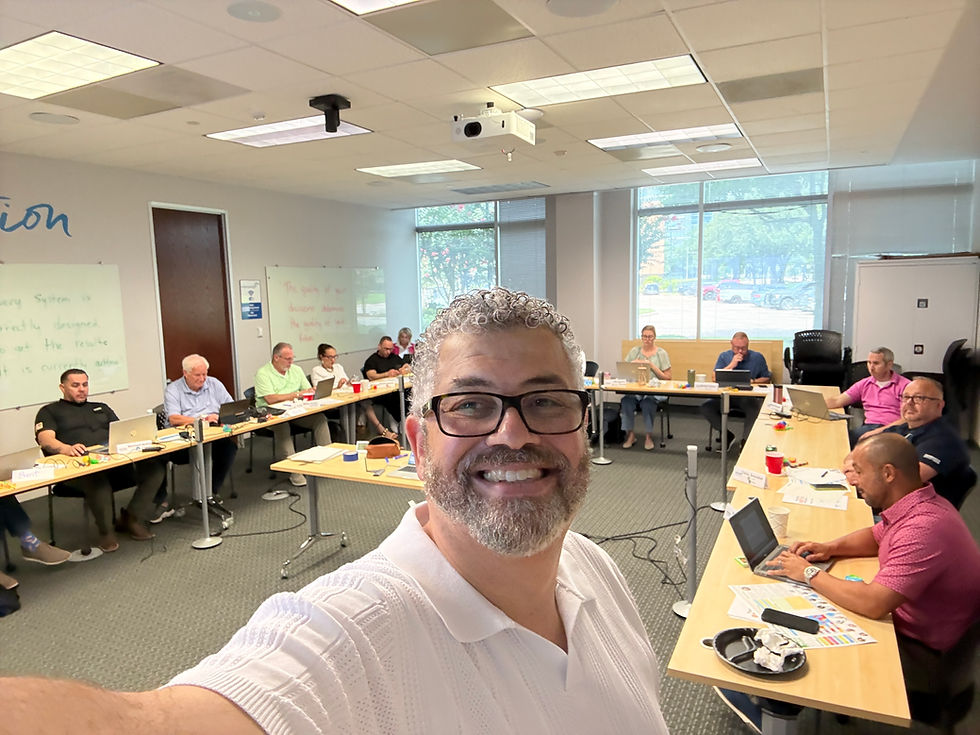
For most of the business conversation about Artificial Intelligence, the headline benefit has been efficiency — do more with less, cut costs, automate the routine. That framing is real, but it misses where AI may create the most durable value for an entire category of businesses. For law firms, engineering practices, consultancies, and other professional service providers, the product is not a widget. It is a relationship, built on trust, responsiveness, and expertise. And in a relationship business, the highest-value application of AI is not cutting cost — it is deepening the relationship. A CEO advisory group in San Clemente, California on July 16, 2026 made this unusually clear.
Nine leaders — a majority of them from professional and knowledge-services firms including estate and tax law, legal services, business consulting, engineering, IT, and coaching — gathered for a GPS Summit workshop that earned perfect marks across every category, with a 5 out of 5 for Quality of Content, Delivery, and Applicability and a 100 percent recommendation rate. And when these leaders were asked what they most wanted from AI, a majority gave an answer that stands apart from most sessions in the GPS Summit series: not cost reduction, not raw revenue growth, but Customer Experience. In a room full of relationship businesses, the leaders instinctively understood that AI's greatest promise is making their client relationships better.
What Nine San Clemente Leaders Revealed About AI in Professional Services
The San Clemente session drew a distinctive concentration of professional and knowledge-services firms, alongside manufacturing, packaging, and logistics. It was also one of the most confident and capable rooms in the series. The survey data reveals a group that has largely moved past the starting line and is now focused on using AI to strengthen what matters most in their businesses — the client relationship:
56% named Customer Experience as their top AI goal. A majority of the room prioritized Customer Experience above revenue growth, cost reduction, and every other outcome — a striking departure from most GPS Summit sessions and a direct reflection of the relationship-driven nature of professional services.
Confidence averaged 7.6 out of 10 — the highest floor in the series. Scores ranged from 6 to 10, with not a single leader below a 6. This unusually high and tight confidence range reflects a group that has real AI experience and a clear-eyed belief in its ability to compete.
67% had a named, accountable AI owner. Two-thirds of the companies had assigned AI ownership to a CEO or general manager, with only one company lacking a clear owner. This is among the strongest ownership profiles in the series — a marker of organizational seriousness about AI.
67% had AI pilots in production. Six of nine companies had already deployed at least one AI initiative into live operation, reinforcing that this was a room of active practitioners rather than observers.
But 78% named talent and skills as their biggest blocker, and 78% had data that was not decision-ready. Even in this capable group, the two persistent gaps of the entire GPS Summit series held: the need for internal AI expertise and the need to organize data into an AI-ready form. Confidence and pilots are not the same as fully developed capability.
The picture, then, is of a sophisticated room — high confidence, strong ownership, real deployment — that is nonetheless bumping against the same ceiling as everyone else: the talent to lead AI well and the data foundation to let it perform. And uniquely, this room's ambition for AI was pointed squarely at the client relationship.
"The workshop part was great because now it is in my email and I can take action. I love that part of it." — San Clemente Workshop Attendee, July 16, 2026
This comment captures something professional service leaders value intensely: the bridge from insight to action. Busy professionals — attorneys, engineers, consultants — do not lack ideas. They lack time and mechanisms to act on them. A workshop that leaves a leader with something concrete and actionable in hand is worth far more to them than one that leaves them merely inspired. This same principle scales to AI adoption itself. The gap between understanding AI's potential and actually implementing it inside a busy professional firm is exactly the gap that a developed internal AI leader closes — turning insight into action systematically, not occasionally.
How AI Deepens Client Relationships in Professional Services
The San Clemente room's focus on Customer Experience points to a truth about AI in professional services that deserves far more attention than it gets. In businesses built on expertise and relationships, AI's most transformative role is not replacing the professional's judgment — it is giving the professional more time, better information, and sharper tools to serve clients exceptionally. Here is how that plays out in practice.
AI Gives Professionals Their Time Back for Clients
The single greatest constraint in most professional service firms is the time of the professionals themselves. Every hour an attorney spends on document review, an engineer spends on routine documentation, or a consultant spends on research synthesis is an hour not spent on the high-value, relationship-building, judgment-intensive work that clients actually pay for and remember. AI changes this equation directly.
Rick Fenelli of Fenelli Law Firm offered a concrete window into this, noting simply:
"We are using Claude for research." — Rick F., Fenelli Law Firm
A law firm using AI for research is a perfect example of AI as time-liberation rather than replacement. The AI accelerates the research; the attorney applies the judgment, crafts the strategy, and builds the client relationship. The result is not a diminished lawyer but a more available one — able to spend more time with clients, respond faster, and deliver a Customer Experience that a slower, more manually-burdened competitor cannot match. When 56 percent of a room prioritizes Customer Experience as their AI goal, this is precisely the mechanism they are reaching for: AI in the back office producing better relationships in the front office.
Faster, Sharper, More Personalized Client Communication
Beyond freeing time, AI directly enhances the quality and responsiveness of client communication — the lifeblood of professional service relationships. AI can draft clear first-pass client updates, summarize complex matters into accessible language, ensure consistent and timely follow-up, and personalize communication at a scale that manual processes cannot sustain. For an engineering firm managing dozens of active projects, a law firm handling numerous client matters, or a consultancy juggling multiple engagements, this Customer Engagement improvement is not cosmetic. It is the difference between clients who feel attended to and clients who feel neglected — and in referral-driven professional services, that difference directly drives Business Growth.
AI also unlocks Customer Insights that were previously buried in unstructured firm data — patterns in which client types are most profitable, which service lines drive the most referrals, where clients tend to experience friction, and what predicts long-term client retention. A professional firm that surfaces these insights can shape its Customer Experience strategy with evidence rather than intuition. This is where the data-readiness gap that affected 78 percent of the San Clemente room becomes so consequential: the insights are latent in the data these firms already have, waiting for the organization and leadership to unlock them.
The Trust and Governance Imperative in Professional Services
Professional services carry a governance obligation that is more acute than in almost any other sector. Attorneys are bound by client confidentiality and privilege. Engineers carry professional liability for their work products. Consultants are entrusted with proprietary client strategy. For these firms, the fact that 44 percent of the San Clemente room still relied on no protections or informal-only AI governance is a significant risk — because a confidentiality breach or an inadequately reviewed AI output in a professional context can carry consequences ranging from malpractice exposure to the loss of a client's trust.
The encouraging counterpoint is that a third of the room had already implemented real governance, blocking sensitive data from AI tools and logging activity. This is the model professional firms need — one that allows them to capture AI's Customer Experience benefits while rigorously protecting the confidentiality and quality standards their professions demand. Building that governance framework, calibrated to the specific obligations of a law firm, an engineering practice, or a consultancy, is one of the most valuable things a developed internal AI leader can do. It is exactly the kind of capability the GPS Summit builds — AI Leadership that understands the profession's constraints as deeply as the technology's possibilities.
Interactive Learning as a Model for AI Adoption
Several San Clemente attendees highlighted the interactive nature of the session as its most valuable feature — one describing it as informative and interactive, another praising the interactive concepts specifically. This preference is instructive.
Professionals learn AI best not by being lectured about it, but by doing it — working with real tools on real problems in real time. This is the same principle that makes the GPS Summit effective: it does not teach AI as a concept to be understood but as a capability to be practiced. For professional service leaders who value action over theory, this hands-on, build-as-you-learn approach is what actually produces the internal expertise their firms need to close the talent gap that 78 percent of the room named as their biggest blocker.
The GPS Summit: AI Leadership Built for Relationship Businesses
The San Clemente room proved that professional service firms are not behind on AI — many are confident, well-owned, and actively deploying. What they need is not motivation but capability: the internal leadership to close the talent gap, organize their data, build profession-appropriate governance, and channel AI directly toward the Customer Experience outcomes they prioritize. The GPS Summit delivers exactly this.
It is a structured, cohort-based AI Leadership development program that takes your most capable high-potential leader and equips them to deploy AI in service of your client relationships — with the governance rigor that professional services demand and the practical, hands-on capability that turns AI ambition into client-facing results.
GPS Summit participants leave equipped to:
Deploy AI to elevate Customer Experience — using AI to free professionals' time, sharpen client communication, and personalize Customer Engagement in the relationship-driven way that 56 percent of the San Clemente room prioritized.
Close the talent and skills gap from within — developing the internal AI expertise that 78 percent of the room named as their biggest blocker, through hands-on, practice-based capability building.
Turn firm data into Customer Insights — addressing the data-readiness gap that affected 78 percent of the room, unlocking the client and profitability patterns latent in existing firm data.
Build governance calibrated to professional obligations — establishing the confidentiality protections, review protocols, and usage standards that let law firms, engineering practices, and consultancies deploy AI without compromising privilege, liability, or client trust.
Drive AI Strategy and Digital Transformation with a single owner — building on the strong ownership base the room already had to convert confidence and pilots into fully developed, measurable AI capability and lasting Competitive Advantage.
To learn more about the GPS Summit and how it develops AI leaders for professional and relationship-driven businesses, visit the GPS Summit overview page or review the full competitive comparison.
Your Clients Will Notice the Difference Before Your Balance Sheet Does
The San Clemente room understood something that the efficiency-focused AI narrative often misses: in a relationship business, the first place AI shows up is in the client experience, and the clients notice it before it ever appears on the balance sheet. The attorney who responds faster and with sharper insight. The engineer who communicates more clearly and proactively throughout a project. The consultant who arrives at every meeting better prepared because AI handled the synthesis. These improvements build the client loyalty and referral momentum that ultimately drives revenue — but they are felt in the relationship first.
That is why a majority of these leaders pointed their AI ambitions at Customer Experience rather than cost. They know their businesses. They know that in professional services, the relationship is the product, and anything that strengthens the relationship strengthens the firm. AI, deployed thoughtfully by a capable internal leader, is one of the most powerful relationship-strengthening tools available to a professional firm today. The firms that grasp this and act on it will pull ahead of competitors still treating AI as a mere cost-cutting exercise.
The San Clemente leaders left their session with the insight in hand and, as one put it, in their email, ready to take action. The GPS Summit is how that readiness becomes lasting capability — developing the internal AI leader who will deploy AI in service of the client relationships that define, differentiate, and grow a professional firm. For any relationship business ready to make its client experience its competitive edge, that leader is the place to start.
When you are ready to develop the AI leader who will strengthen your client relationships, enroll them in the GPS Summit here. To learn more about BREATHE! Experience and the full program, visit breatheexp.com.
If AI gave every professional in your firm back the hours they lose to routine work, how much better would your clients' experience be — and who would you trust to make that happen?


Comments