
AI Is Not Just for Tech Companies. It Is for Main Street.

Updated: Aug 18

The Biggest Myth About Artificial Intelligence in Business
There is a quiet assumption that has slowed Artificial Intelligence adoption more than any technical barrier ever could: the belief that AI belongs to someone else. To the software companies. To the venture-backed startups. To the coastal tech elite with data science teams and unlimited budgets. Under this assumption, the water utility, the forklift dealer, the garden center, the engineering firm, and the family-run manufacturer are spectators to the AI revolution rather than participants in it. That assumption is not just wrong. It is expensive. And on July 14, 2026, a CEO advisory group in Orange County, California proved exactly how wrong it is.
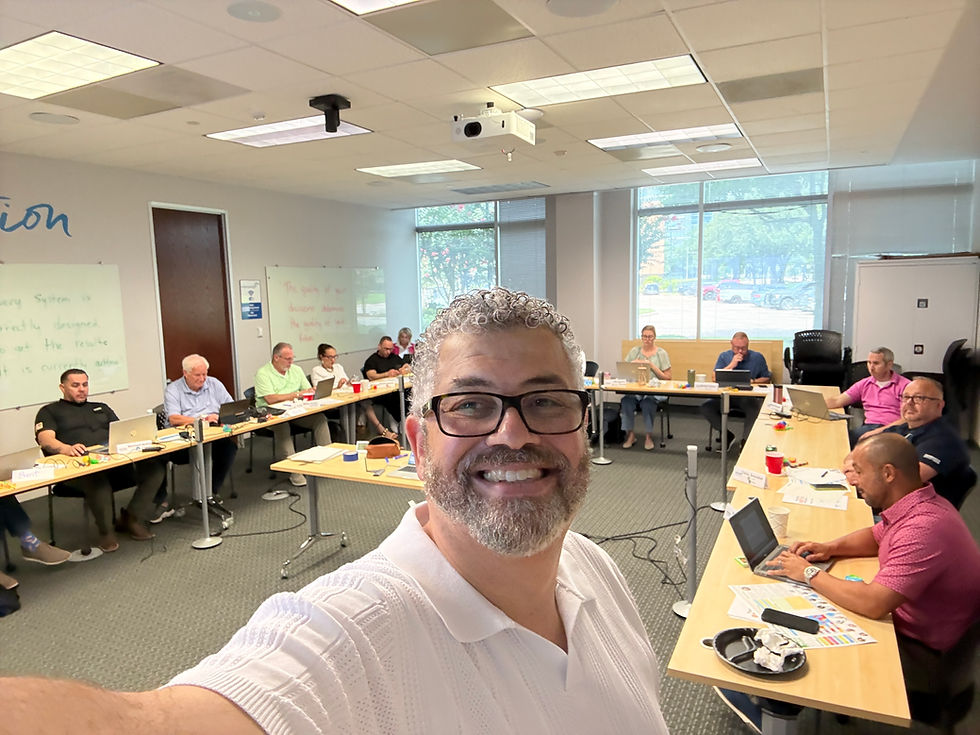
Eleven leaders from some of the most fundamentally non-tech industries in the economy — water resources, civil engineering, plastic injection molding, forklift sales and service, garden retail, wedding hospitality, and food and consumer packaged goods — gathered for a GPS Summit workshop and walked out with a different understanding of what AI is and who it is for. The session earned perfect marks across every category — a 5 out of 5 for Quality of Content, Delivery, and Applicability, with a 100 percent recommendation rate. But the real story is in what these leaders realized: that AI is not a spectator sport reserved for tech companies. It is a Business Growth tool available to every organization willing to develop the leadership to use it.
A Room That Looked Like the Real Economy
What made the Orange County session so instructive was the composition of the room. This was not a gathering of digital-native businesses. It was a cross-section of the companies that actually keep communities running — the ones that deliver clean water, build infrastructure, manufacture components, sell equipment, grow plants, host celebrations, and put food on shelves. If AI has genuine value for businesses like these, then the myth that AI is only for tech companies collapses entirely. The survey data from the room makes clear both the size of the opportunity and the specific gaps standing between these companies and it:
73% had no single accountable owner for AI outcomes. Eight of eleven companies had no clear individual responsible for driving AI forward. For traditional, operationally-focused businesses, this is often because AI has never fit neatly into an existing role — which is precisely why a dedicated internal AI leader matters so much.
73% had no KPIs tied to AI outcomes, and 73% had no AI safety governance. The same share of companies lacked measurement and lacked protections — a consistent pattern showing that where AI ownership is absent, the structures that ownership would build are absent too.
82% had data that was not decision-ready. Only two of eleven companies had a clean, labeled dataset with access controls. For businesses that have spent decades generating operational data across disconnected systems, this is the foundational work that has to happen before AI can deliver its full value.
64% named talent and skills as their biggest blocker. The leading obstacle across the entire GPS Summit series appeared again here. For non-tech industries especially, the perceived shortage of AI-capable people is the single biggest thing standing between interest and action.
100% wanted to learn about developing an internal AI leader. Every single leader in the room — from the water utility manager to the forklift dealer to the garden center executive — agreed that the path forward runs through developing a person to own AI. In a room of traditional businesses, that unanimity is a powerful rebuttal to the idea that AI is not for them.
AI confidence averaged 6.3 out of 10, ranging from 3 to 10, and nearly half the group already had at least one AI pilot in production. These are not companies sitting on the sidelines. They are companies actively working to close the gap between where they are and where they know they need to be — and they represent millions of businesses like them across every region and sector of the economy.
"Super impressive and instantly useful. AI does not feel like it is for everyone, and this workshop is a great invitation to jump in."— Orange County Workshop Attendee, July 14, 2026
This comment names the myth and then dismantles it in the same breath. AI does not feel like it is for everyone — that is the perception. This workshop is a great invitation to jump in — that is the correction. The gap between those two statements is where most traditional businesses are stuck: aware that AI matters, but unconvinced that it is genuinely accessible to a company like theirs. Closing that gap is the first and most important thing any AI development experience can do. And the leaders who cross it discover that AI is not only for them — it may be one of the most powerful Competitive Advantage tools available to a traditional business willing to move before its competitors do.
Why Traditional Businesses May Have the Most to Gain
Here is the counterintuitive truth that the Orange County room began to grasp: traditional, non-tech businesses often stand to gain more from AI than the tech companies do — precisely because they are starting from a lower baseline of automation and digital efficiency. A software company has likely already optimized many of its workflows. A water utility, an engineering firm, or a family manufacturer frequently has years of manual processes, untapped operational data, and repetitive administrative work that AI can transform. The upside is enormous, and it is largely uncaptured.
Augmentation, Not Replacement, in Skilled Industries
One of the most important reframings for traditional and skilled industries came from W David Byrum of Civiltec Engineering, whose comment captured the healthy, accurate way for an expertise-driven business to think about AI:
"Our engineering field has lagged in AI assistance in the past. We are catching up slowly. Developing full engineering solutions is still a human function. We want to get better at adapting to AI assistance in our analyses and work products."— W. David B., Civiltec Engineering, Inc.
This is exactly the right mental model. In skilled industries — engineering, healthcare, professional services, the trades — AI does not replace the expert judgment that defines the profession. It augments the work surrounding that judgment: the analysis, the documentation, the reporting, the research, the routine communication. For an engineering firm, AI can accelerate technical analysis and work-product generation while leaving the actual engineering solution in expert human hands. For a water utility, it can surface Customer Insights from operational data, optimize maintenance planning, and improve public Customer Engagement. The human function is preserved and strengthened, not diminished. And capturing this requires the same thing every company in the room said they wanted — a developed internal AI leader who understands both the business and the technology.
The Imagination Barrier Is the Real Barrier
For traditional businesses, the hardest part of AI adoption is often not technical — it is imaginative. Leaders struggle to see how a technology they associate with chatbots and tech startups applies to running a garden center, a wedding venue, or a plastics manufacturer. That is why the most valuable thing a workshop can do for these companies is expand what they can envision. Two Orange County attendees named exactly this effect.
"You expanded my imagination, and I am looking forward to implementing this at my organization."— Carlos M., Jurupa Community Services District
Kari Martinez of Armstrong Garden Centers described the workshop as an inspiration for the efficiencies her organization could accomplish by embracing and working with AI. When a garden retail executive and a community services district manager both leave a session with expanded imagination about AI's role in their operations, the myth that AI is only for tech companies is not just challenged — it is replaced with something far more useful: a concrete vision of AI-driven efficiency, Customer Experience improvement, and Business Growth in a decidedly non-tech context. That vision is the raw material of an AI Strategy. What turns it into results is a leader equipped to build it.
Marketing and Growth: The Universal Entry Point
Scott Henningsen of L.A. Lift Services identified a goal that nearly every traditional business shares — he is looking for help with marketing and company growth. This is often where AI delivers its most immediate, visible wins for non-tech companies, because AI in Marketing does not require deep technical infrastructure to produce results. It can generate content, personalize customer outreach based on Customer Insights, optimize advertising spend, and automate the Customer Engagement workflows that drive revenue — capabilities that were once available only to companies with large marketing departments.
For a forklift dealer, a garden center, a wedding venue, or a food company competing in a crowded market, AI-powered marketing and Customer Experience improvements translate directly into the kind of measurable Competitive Advantage that grows revenue and market share. And this is deployable now, by a developed internal leader, without a Silicon Valley budget or a data science team. It is one of the clearest proofs that AI is genuinely for Main Street, not just for tech.
The Data Foundation Every Traditional Business Must Build
The finding that 82 percent of the Orange County companies had data that was not decision-ready reflects a reality specific to established, traditional businesses. These are organizations that have generated enormous amounts of operational data over years or decades — but generated it in systems that were never designed for AI, scattered across departments, stored in incompatible formats, and never structured for analysis. Before AI can deliver meaningful Customer Insights or drive genuine Digital Transformation, this data has to be organized and made accessible.
This is not a reason for traditional businesses to feel behind. It is an opportunity that most of their competitors have not yet seized. The company that builds a clean, AI-ready data foundation — especially in a traditional sector where few rivals have done so — creates a Competitive Advantage that is genuinely difficult to replicate, because it rests on proprietary operational data that no competitor possesses. Building that foundation requires a leader who understands what AI needs from data and has the authority to drive the necessary changes. That is exactly the capability the GPS Summit develops.
The GPS Summit: Bringing AI Leadership to Every Industry
The Orange County room demonstrated that AI belongs to every industry — and that the leaders in traditional businesses know it, want it, and are ready to build it. What they need is not more evidence that AI matters, and not another tool. What they need is the developed internal leader who can translate AI's potential into results within the specific realities of a water utility, an engineering firm, a manufacturer, a retailer, or a service business. That is precisely what the GPS Summit provides.
It is a structured, cohort-based AI Leadership development program that takes your most capable high-potential leader and equips them with the AI Strategy, governance, data, and execution capabilities to build genuine AI capability from within — regardless of whether your business writes software or pours concrete, grows plants or plans weddings.
GPS Summit participants leave equipped to:
Become the accountable AI owner — filling the leadership gap that 73 percent of the Orange County companies were missing, with the mandate and capability to drive AI forward in a traditional business context.
Build AI Strategy, KPIs, and governance as an integrated system — closing the triple gap in ownership, measurement, and protection that defined the room, with governance tuned to each industry's regulatory and trust requirements.
Turn decades of operational data into an AI-ready asset — addressing the data-readiness gap that affected 82 percent of the room, unlocking the proprietary Customer Insights that traditional businesses are uniquely positioned to own.
Deploy AI in Marketing and Customer Experience for immediate impact — capturing the marketing and growth wins that non-tech businesses can achieve quickly, driving Customer Engagement and revenue without a large technical team.
Lead Digital Transformation while preserving human expertise — applying AI as augmentation rather than replacement, strengthening the skilled judgment at the heart of engineering, healthcare, trades, and service businesses.
To learn more about the GPS Summit and how it brings AI Leadership to businesses in every industry, visit the GPS Summit overview page or review the full competitive comparison.
The Companies That Jump In Now Will Define Their Industries
The most important thing the Orange County session revealed is not in any single statistic. It is in the collective realization of a room full of traditional-business leaders that AI is theirs to claim. The water utility that expands its imagination, the engineering firm that embraces AI augmentation, the forklift dealer that deploys AI-driven marketing, the garden center inspired by the efficiencies it can achieve — these are not spectators to the AI revolution. They are exactly the companies that will define the next decade of their industries, precisely because so many of their competitors still believe AI is not for them.
That misplaced belief is the opening. Every traditional business that waits, assuming AI belongs to the tech companies, cedes ground to the traditional business in the same sector that decided otherwise. The Competitive Advantage available right now is not reserved for the digitally native. It is available to any water utility, manufacturer, retailer, or service company willing to develop the leadership to seize it — and to do so before the myth finally breaks and everyone rushes in at once.
Eleven Orange County leaders left their session understanding this, and all eleven wanted the same next step: to develop the internal AI leader who would turn their expanded imagination into real capability. The GPS Summit is where that leader is built. And for any traditional business ready to stop watching the AI revolution and start leading it, the invitation to jump in is open.
When you are ready to develop the internal AI leader who will bring AI capability to your business, enroll them in the GPS Summit here. To learn more about BREATHE! Experience and the full program, visit breatheexp.com.
What could your business accomplish with AI that you have been assuming was only possible for the tech companies — and who on your team could prove that assumption wrong?


Comments