
Mandate Without Framework: How Operations Leaders Break the AI Research Loop


Executive Summary
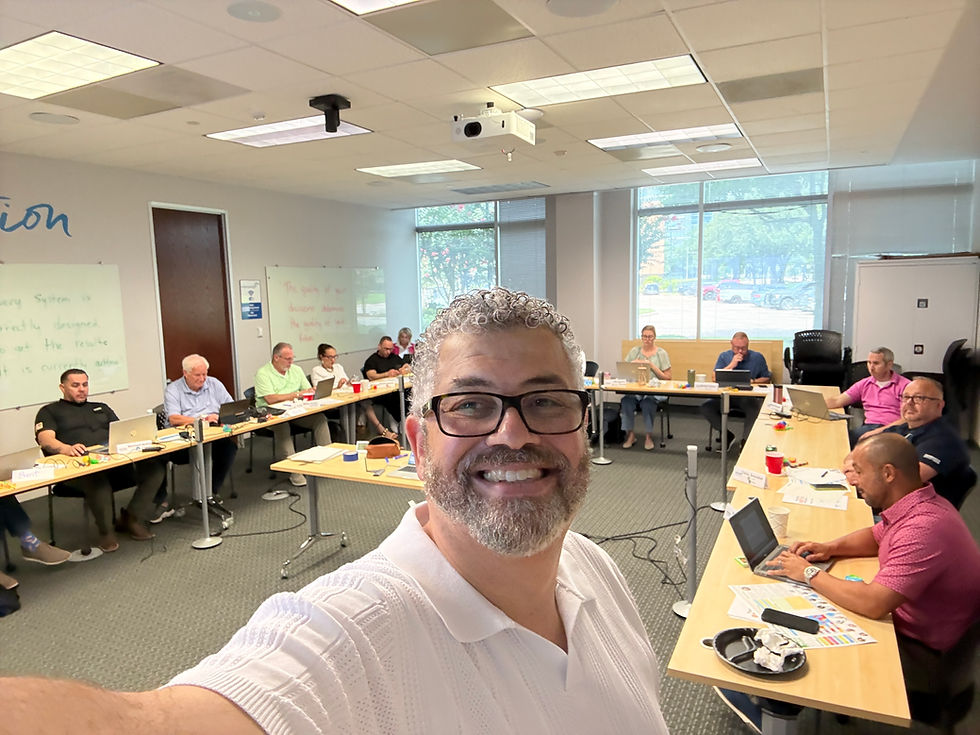
This brief is based on responses from nine midmarket operations leaders at a workshop in Houston on June 25, 2026. Findings are directional and should be validated against larger samples before assuming organization-wide patterns.
No clear ownership is the critical gap: Five of nine respondents (56 percent) have no designated AI owner; one has a working group with no single throat to choke. Only three have clear functional leadership assigned to AI decisions. This pattern appears across construction, manufacturing, oil and gas, and first responder operations.
Talented teams are researching, not executing: Eight of nine companies have shipped zero AI pilots to production. The median response speed suggests quarterly planning cycles, yet no clear mechanism moves ideas from workshop to proof point.
Confidence for 2027 is modest: Average confidence that their company will be competitive in AI by 2027 is 6.3 out of 10. For organizations that have bet their strategy on AI readiness, this gap between mandate and conviction is material.
Talent and cost reduction are the dual pull: Talent and skills gap is the top outcome leaders want to address (four of nine) and the top blocker (four of nine). Cost reduction is the secondary target (three of nine). Neither requires a three-year transformation; both reward proof points that land in the next quarter.
Governance is weak and data readiness is mixed: Four companies have no formal protections in place; three more rely on informal habits. Data readiness varies: four have raw data they could label; three have only scattered exports; two have nothing accessible. This is not a blocker to starting small.
The workshop resonated, with one key adjustment: Satisfaction across content quality, delivery, and applicability averaged 4.7 out of 5. One instructor insight proved especially relevant: one respondent noted that operations and manufacturing use cases would have been more valuable than marketing examples. For operations leaders, the gap between their mandate and their industry's application of AI remains acute.
What next: The most actionable finding is structural: operations teams with a named owner and a single KPI show forward movement. Teams without either stall. This brief outlines a function-level framework to install that structure and produce a credible proof point within four to eight weeks.
What the Survey Reveals About AI Readiness
Outcomes leaders want
Four of nine respondents identified talent and skills as the top outcome they want AI to address. The second-largest group, three respondents, prioritized cost reduction. One each cited risk and compliance, and customer experience.
This reflects a pragmatic operations mindset: AI is a tool to amplify capacity (close the talent gap) or reduce cost per unit of output. For operations leaders, the narrative is not transformation or disruption. It is leverage.
The dominance of talent as the desired outcome is notable: it suggests that these leaders believe AI will let them do more with their current team, or that they expect to fill gaps faster. Neither requires a massive budget allocation. Both are testable within a function.
What's blocking progress
Talent and skills emerge again as the named blocker, cited by four respondents. Two cited leadership buy-in. Two cited tech stack or tool selection. One cited regulation or compliance.
The talent blocker and talent outcome are the same problem viewed from different angles. Leaders want to use AI to address talent constraints but believe they lack the skills to implement it. This is a classic catch-22: you need people who understand AI to build AI, but you need AI to fill people gaps.
Buy-in is mentioned by two respondents. This deserves note because it is fundamentally different from the other blockers. Buy-in is a structural problem, not a capability problem. Competent teams can generate buy-in by producing results. Teams waiting for buy-in before building results wait indefinitely.
The ownership gap and why it matters
Five of nine respondents (56 percent) have no clear owner for AI. One has a working group but no single owner. Three have a functional leader assigned. This zero-owner pattern appears across all company sizes and industries in the sample.
When there is no owner, several dynamics follow in order:
Decisions cascade into the general counsel's inbox. Without a named owner, questions about risk, data handling, and vendor selection rise to the most conservative stakeholder. This slows approval.
Pilots remain experiments. An experiment without an owner is a research project. It has no success metric, no planned migration path, and no sponsor when obstacles appear. Eight of nine respondents have shipped zero pilots to production. The lack of ownership is a contributing factor.
Governance applies retroactively, if at all. Four companies have no protections in place. Three more enforce rules only partially. Without an owner, governance becomes firefighting rather than design. The owner role includes defining the rails before the team starts moving.
Response speed stalls. One measure of ownership is how fast the function makes decisions. Responses in the sample ranged from same-day to quarterly to "rarely, in crisis mode." Functional leaders assigned to AI decisions in the sample all reported faster response speeds (within a week or month). No-owner teams reported slower speeds across the board.
For operations leaders, this pattern has a specific implication: the mandate (figure out AI) cannot be executed without designating who gets to make the decision. That person does not need to be the CEO or the Chief Innovation Officer. It can be the VP of Operations, the Plant Manager, the Supply Chain Director, or the IT Manager. What matters is that one person is accountable for moving the needle, and everyone else knows it.
Industry Intelligence: How Five Sectors Are Responding to AI Right Now
Commercial Construction and Mechanical Services
What's changing: Commercial construction firms are deploying AI to reduce rework, accelerate permitting, and improve crew utilization. Generative AI is being applied to permit applications, job-site image analysis, and supply chain coordination.
Where AI is being applied: Permit and document processing (leveraging generative AI to interpret building codes and flag inconsistencies); site documentation and quality control (image analysis to detect non-compliance); crew scheduling and logistics (predictive dispatch based on weather, material delivery, and labor availability).
Common pitfalls: Firms implement tools without integrating them into daily workflows, leading to dual entry and abandonment. Firms also under-invest in data standardization; if site reports, photos, and schedules are not structured, AI tools trained on them fail quickly.
Context and stats: The construction industry accounts for approximately 10 percent of U.S. GDP, with heavy reliance on manual documentation and site coordination. Penetration of AI-driven quality and logistics tools in mid-market construction firms is estimated at 15-20 percent (training-data; verify before publishing). Organizations that have implemented site image analysis report reductions in rework-related costs of 8-12 percent within the first year (training-data; verify before publishing).
Oil and Gas Operations
What's changing: Upstream and midstream operations are using AI for predictive maintenance, optimization of extraction efficiency, and supply-chain resilience. Real-time sensor data is being fed into machine-learning models to predict equipment failure and optimize production schedules.
Where AI is being applied: Predictive maintenance (algorithms trained on historical failure and sensor data to forecast when equipment needs service); production optimization (models to adjust extraction rates, pressure, and temperature based on current and forecasted conditions); logistics and vendor management (algorithms to route tanker trucks and schedule maintenance windows).
Common pitfalls: Legacy equipment generates incompatible data formats; teams try to retrofit AI onto systems designed before data standards existed. Governance around data access and model changes lags, leading to siloed tools that no one trusts at scale.
Context and stats: AI-driven predictive maintenance in oil and gas reduces unexpected downtime by an estimated 15-25 percent compared to calendar-based servicing (training-data; verify before publishing). Mid-market operators report that achieving a 10 percent production efficiency gain (through optimization modeling) requires 6-12 months of model refinement and 2-3 cross-functional cycles to debug data pipelines (training-data; verify before publishing).
Fire, Hazmat, and First Responder Services
What's changing: First responder supply companies and hazmat logistics firms are using AI to predict demand patterns, optimize warehouse and vehicle routing, and reduce response times. Government and contract labor components add complexity; AI is being applied to staffing and compliance forecasting.
Where AI is being applied: Demand forecasting (predicting surges in calls and needed supplies based on historical, seasonal, and real-time patterns); resource allocation (assigning vehicles, crews, and equipment dynamically based on predicted demand and current location); compliance and risk flagging (monitoring for regulatory changes and flagging staff certifications that are about to lapse).
Common pitfalls: Data sensitivity (government contracts often restrict data movement and tool selection) slows deployment. High staff turnover means training on new tools is constant; organizations under-invest in user adoption.
Context and stats: First responder agencies and hazmat suppliers that have deployed demand-forecasting AI report reduction in equipment shortages by 10-18 percent and improvements in average response time of 8-15 percent (training-data; verify before publishing). Compliance tracking via AI reduces missed recertifications by approximately 30 percent in organizations with high turnover (training-data; verify before publishing).
Precast Concrete and Specialty Manufacturing
What's changing: Manufacturers of precast concrete, modular building components, and specialized fabricated goods are using AI for predictive quality control, production scheduling, and raw-material optimization. The move from order-to-delivery cycles of weeks to days relies on tighter scheduling and fewer defects.
Where AI is being applied: Quality control (vision systems trained to detect surface defects, dimensional errors, and assembly issues faster than manual inspection); production scheduling (algorithms to route jobs through mills and cure schedules to minimize idle time); material forecasting and waste reduction (predicting mix designs and reducing scrap based on job specifications).
Common pitfalls: Quality systems built on manual inspection are hard to instrument; firms struggle to capture the data quality inspectors use intuitively. Models work in controlled environments but fail when shift crews vary or raw material batches change.
Context and stats: Manufacturers implementing AI-driven quality control reduce defect escape rates by approximately 20-35 percent and accelerate inspection cycles by 40-50 percent (training-data; verify before publishing). Production scheduling optimization in specialty manufacturing reduces cycle time by an estimated 5-15 percent, depending on product mix complexity (training-data; verify before publishing).
Industrial Supply Chain and Operations (Inferred from Adjacent Sectors)
What's changing: Multi-site operations, supplier networks, and inventory-heavy businesses are deploying AI for demand sensing, vendor management, and inventory optimization. The goal is to reduce working capital tied up in inventory while reducing stockouts and expedited freight.
Where AI is being applied: Demand sensing (combining point-of-sale data, forecast signals, and leading indicators to improve forecast accuracy); vendor performance and risk assessment (monitoring delivery, quality, and financial health signals to flag at-risk suppliers); dynamic inventory allocation (routing stock to locations based on predicted demand and current position).
Common pitfalls: AI models are only as good as the demand signal fed into them. Firms with poor demand forecast visibility, volatile customer ordering patterns, or fragmented data sources find models drift quickly. Governance of inventory allocation decisions is challenging; operations teams fear loss of control.
Context and stats: Organizations deploying demand-sensing AI in industrial supply chains improve forecast accuracy by 8-15 percent on average, with larger gains (15-30 percent) in stable, high-volume categories (training-data; verify before publishing). Working capital improvements from optimized inventory allocation range from 5-12 percent of inventory value in the first year (training-data; verify before publishing).
What High-Performing Organizations Are Doing Differently
Among the survey respondents, only one company had shipped an AI pilot to production and tied it to a clear KPI with a named owner and regular review. That organization's approach differed from the stalled majority in five ways:
1. Ownership is named and accountable. The functional leader owns the decision, the KPI, and the review cycle. This person is not a project manager or committee chair. They own the outcome.
2. Capability is built first, then deployed. Before selecting a tool or vendor, the organization mapped what it needed to learn (data handling, model interpretation, workflow integration). That learning happens on a small pilot before scaling.
3. Governance is defined before pilots begin. The organization clarified what decisions can be made by the team (e.g., model parameter tuning), what decisions require review (e.g., vendor changes, significant accuracy drops), and what decisions escalate to legal or compliance. This framework prevents rework and enables speed.
4. Proof points are designed for conversion, not just learning. The pilot is structured so that success on the KPI unlocks resources or mandate for the next phase. Pilots that teach but do not convert consume time without building momentum.
5. Measurement is constant and honest. The organization tracks the KPI weekly or bi-weekly, not at the end of the pilot. This means course corrections happen early, not after six months of drift.
Recommendations Informed by the Workshop Data
The recommendations below are drawn from the survey's ownership gap, the lack of shipped pilots, and the dual pull of talent and cost reduction. They are organized by implementation span: quick wins (installable in days to two weeks) and deeper changes (four to twelve weeks).
Quick Wins
1. Name your AI owner this week (addresses: ownership gap, buy-in blocker) Designate a single leader to own the AI decision for your function. This person does not need a new title or budget. They need decision rights and a defined review cadence (bi-weekly minimum). Make the assignment clear to the team and to your CEO. In the survey sample, the absence of a named owner was the single strongest predictor of stalled progress.
2. Define one starting KPI and tie it to cost or capacity (addresses: talent/cost outcomes, proof point design) Pick a single metric that matters to your operations KPI: cost per unit, time to fulfill, quality defect rate, or labor utilization. Connect a small AI experiment (e.g., forecasting, quality inspection, scheduling) directly to that metric. Measure it before and after the pilot. Frame the pilot as a proof point, not a research project.
3. Audit your data for a quick-start use case (addresses: data readiness blocker) Ask your operations team which decisions they make repeatedly and would make faster or better with real-time information. Map those decisions to the data you have on hand (whether in Excel, your ERP system, or scattered reports). You likely have enough to start. Four of nine survey respondents reported having raw data they could label; two more had scattered exports. That is sufficient for a four-week pilot on a specific use case (e.g., "predict which job will slip; forecast demand for this supply category").
4. Lock in a four-week proof-point sprint (addresses: execution vs. research, ownership, governance gaps) Set a calendar date to begin and end a focused AI experiment. Assign the owner, define the KPI, block the team time, and commit to a review-and-decision date. Four weeks is long enough to move from "what if" to "here are the results." It is short enough that the team stays focused. Do not start a pilot without an end date and a decision trigger.
Deeper Changes
5. Build a governance framework for AI decisions within your function (addresses: governance, risk/compliance blocker) Define three tiers of decisions: (a) what the AI team can decide autonomously (e.g., model parameter tuning, test-and-learn iterations), (b) what requires review with your owner and one peer (e.g., deployment to production, changes in data sources), and (c) what escalates to legal, finance, or executive leadership (e.g., new vendor selection, significant data access changes, changes to decision logic that affect compliance). Write this down. Share it with your leadership and your team. Four of nine survey respondents have no formal governance; this is the fastest way to reduce that gap.
6. Design pilots for conversion, not just learning (addresses: research-without-execution trap) When you design a pilot, build in an explicit decision point before it ends. The decision is not "Do we like this?" but rather "Does the KPI math work well enough to justify the cost and effort of scaling?" If yes, outline what the next phase looks like (e.g., expansion to two locations, integration with the ERP system, staffing plan). If no, clarify what you learned and why, and move to a different use case. Pilots that end in "interesting, but no clear next step" teach but do not scale. Eight of nine respondents are in that status; this change breaks the pattern.
7. Invest in a small cross-functional review cadence (addresses: governance, response speed, alignment) After the proof point, establish a bi-weekly or monthly review with your owner, the operations team lead, and one finance or IT stakeholder. Agenda: KPI trend, blockers, data quality issues, any escalations. This prevents siloing and keeps non-owners informed. It also creates a predictable place for escalations instead of ad hoc email chains. Most teams in the survey reported quarterly response speed; a bi-weekly cadence is a step up without being burdensome.
8. Map your talent gap to specific AI roles you can start filling now (addresses: talent/skills outcome and blocker) Talent was cited as both the desired outcome and the top blocker. This is not a sign to wait for external hiring; it is a sign to be specific. Identify the three to five AI-adjacent skills your team needs now: e.g., "someone who can assess data quality and prepare datasets," "someone who can interpret model outputs," "someone who can integrate model predictions into our scheduling workflow." These are not data scientists. They are operations specialists with data discipline. This is more recruitable than "hire an AI expert."
9. Create a quarterly "AI readiness" check tied to your business cycle (addresses: confidence gap, governance, measurement) Define three to five readiness metrics for your function: e.g., "number of active pilots," "percent of decisions tied to a named owner," "percent of team trained on the governance framework," "AI KPI variance vs. target." Review quarterly alongside your operational business metrics. This keeps AI moving from "mandate and research" into "strategic program with cadence and measurement."
Continue the Conversation at GPS Summit
The gap between having a mandate and having a framework is not unique to one function or one industry. At the GPS Summit, you will meet peer operations leaders navigating the same territory: designing their first proofs of concept, installing ownership and governance, and building the case for investment. Bring your function's most pressing use case. Leave with an actionable 90-day plan and a peer cohort to execute it with.


Comments